Event Lead Generation: 16 Strategies for Conferences and Professional Events [2026]
Event lead generation is the process of using conferences, trade shows, webinars, and other event formats to attract and capture high-quality B2B prospects. This lead generation strategy builds trust, shortens the sales cycle, and provides a consistent flow of qualified leads for nurturing by offering real-time and interactive experiences.
The strategies to generate successful event and conference leads include identifying ideal profiles and target persons, defining and setting clear objectives, planning and organizing the event, working with organizers, leveraging virtual and hybrid events, setting up registration forms and session sign-ups, and actively interacting with potential leads.
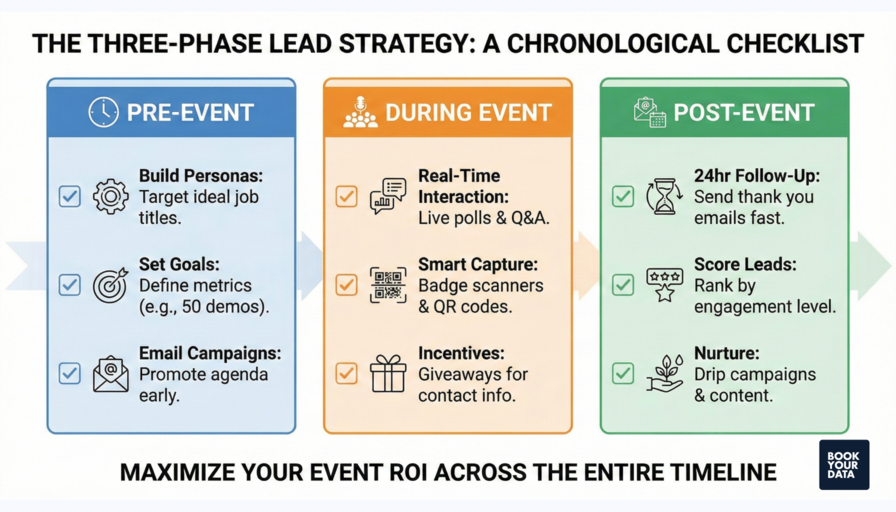
These strategies are important because events provide direct interactions, help qualify leads through tracking, support network marketing, and attract global audiences through recorded content.
What are the strategies to generate event leads?
The strategies to generate successful event and conference leads are described in the table below.
| Strategy | Action Step | Key Benefits |
|---|---|---|
| Identify ideal profiles and target personas | Build buyer personas by analyzing job titles, company sizes, and industries to attract, before the event. | Improves conversion rates, avoids wasting resources, and provides sales teams with qualified leads. |
| Define and set clear objectives | Set measurable goals like lead capture numbers, demo requests, and revenue targets before the event. | Guides budget allocation, justifies event spending, and measures ROI accurately. |
| Plan and organize the event | Choose format, venue, speakers, create promotional materials, and coordinate logistics 6-12 months before large events. | Prevents technical problems, protects brand reputation, and increases lead generation opportunities. |
| Collaborate with event organizers | Partner with organizers for booth placement, speaking slots, and access to attendee networks. | Reduces planning burden, reaches larger audiences, and gains credibility through speaking opportunities. |
| Leverage virtual and hybrid events | Host online events that remove geographic limits and reduce costs compared to physical venues. | Tracks attendee behavior, generates more data points, and maximizes reach with lower costs. |
| Use email marketing campaigns for promotion | Send targeted emails before, during, and after the event to share event agendas and encourage registrations. | Drives most registrations, A/B testing improves open rates, and tracks conversion metrics. |
| Implement networking sessions | Schedule structured breaks and roundtables for direct conversations between sales teams and prospects. | Creates warmer leads than booth visits, qualifies leads through direct conversation, and builds relationships. |
| Set up registration forms and session sign-ups | Collect contact information through forms with thoughtful profiling questions about tools and budgets. | Helps in lead scoring, shows topic interest, and flows into CRM systems. |
| Actively interact with potential leads | Set up staff booths, conduct live polls, run Q&A sessions, and offer product demonstrations during events. | Turns passive attendees into active prospects, answers questions in real time, and qualifies leads directly. |
| Provide valuable insights through presentations and workshops | Offer insightful presentations, workshops, and sessions with research data, case studies, and actionable insights. | Builds trust, positions company as industry expert, and creates digital marketing content for future campaigns. |
| Collect contact information using smart tools | Use badge scanners, mobile apps, QR codes, and virtual platforms to automate lead capture and reduce manual errors. | Real-time CRM syncing reduces data entry errors and tracks representative performance. |
| Offer incentives or giveaways | Provide discounts, exclusive content, or branded items in exchange for contact information. | Motivates booth visits, creates urgency, and attracts higher-quality leads. |
| Integrate technology for real-time lead capture | Connect event platforms with CRM systems through APIs for instant data transfer and lead scoring. | Reduces follow-up delays, prevents duplicate records, and activates email sequences automatically. |
| Organize and analyze collected leads data | Assign lead scores based on job title, engagement level, and stated needs to separate qualified prospects. | Prioritizes high-value leads for follow-up, measures cost per lead, and tracks conversion rates. |
| Send personalized follow-up emails after the event | Send thank-you emails within 24-48 hours, which reference specific sessions and conversations with clear calls to action. | Higher response rates, guides next steps, and segments by engagement level. |
| Nurture event leads through content marketing | Create blog posts, case studies, white papers, and drip campaigns that expand on event topics over time. | Lower costs than outbound marketing, generates more leads, and maintains visibility during long sales cycles. |
1. Identify the ideal profiles and target personas
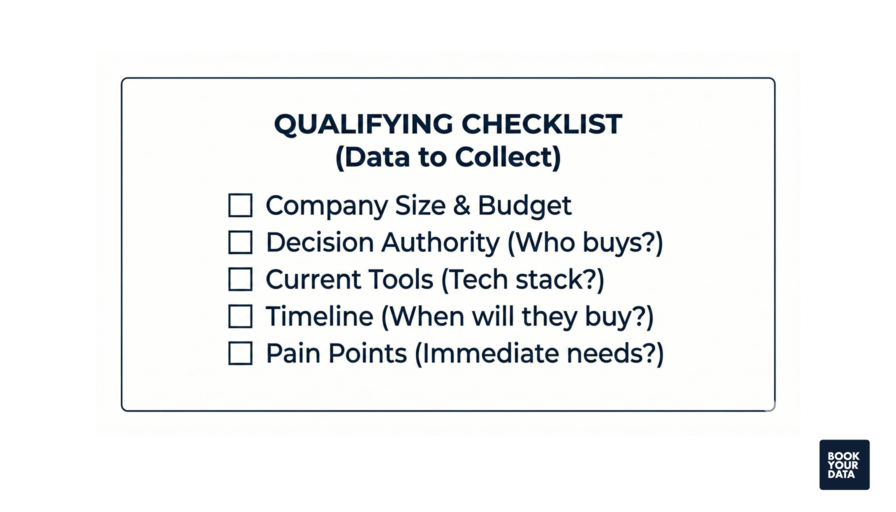
Event lead generation requires companies to identify ideal customer profiles before selecting venues or speakers. Sales teams build buyer personas of potential customers that include their decision-making authority, budget control, and purchasing timelines, while marketing teams use these personas to design event content, select speakers, and prepare promotional messages. Companies target specific job officials who control budgets, such as chief technology officers, marketing directors, and sales managers.
Attendee qualification starts before registration by asking screening questions about company size, current tools, and immediate needs. These pre-event surveys help businesses identify topics that interest attendees the most and create content that focuses on real business challenges.
Companies avoid wasting resources on attendees outside their target market. Targeted lead generation improves post-event conversion rates and provides sales teams with high-quality leads that match their ideal customer profiles. Tools like BookYourData offer more than 100 data attributes to help companies build accurate target lists before events.
2. Define and set clear objectives
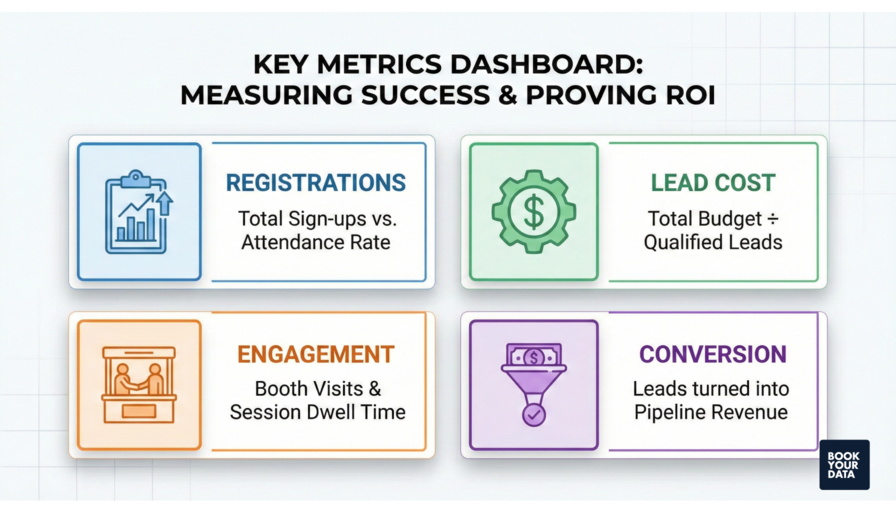
Event objectives guide every planning decision from budget allocation to content creation. Companies set measurable goals such as capturing new leads, scheduling sales meetings, or generating revenue in the pipeline. Event objectives include specific engagement metrics, like email collection rates, booth visit numbers, session attendance figures, and demo request counts. Marketing teams match these event goals with expected revenue targets and annual growth plans, while sales teams set conversion rate targets based on past event performance data.
Clear objectives help teams to assess speaker selection, booth design, promotional budgets, and follow-up strategies. These pre-event objectives include awareness metrics like social media mentions and website traffic increases, and post-event objectives measure lead qualification rates and improvement in the sales cycle. Defined goals help teams to justify event budgets to executives, and companies decide between hosting large conferences or limited roundtables.
3. Plan and organize the event
Event planning starts 6 to 12 months before the event date for large conferences and shorter timelines for smaller webinars, according to an article titled “Event Planning Timeline” by LYYTI. Planning teams choose between in-person, virtual, and hybrid formats based on target audience preferences and budget limitations, while venue selection is based on attendee capacity, location accessibility, technical capabilities, and event catering options. Proper event agendas create a balance between educational content, networking opportunities, and sponsor presentations.
Brands book motivational speakers, panelists, and workshop facilitators who attract target personas. Marketing teams create promotional materials, such as landing pages, email sequences, social media posts, and paid advertisements, while registration systems integrate with CRM platforms to capture attendee data automatically.
Event budgets include venue costs, speaker fees, catering expenses, technology rentals, and promotional spending. Virtual events require streaming platforms, interactive features, and technical rehearsals for registration processes, payment systems, and attendee communication workflows. Proper event planning leads to smooth event execution, prevents technical problems, protects the brand’s reputation, and increases lead generation opportunities.
4. Collaborate with event organizers
Event organizers provide access to reliable attendee networks and promotional channels that help small companies and individuals scale their reach. These organizers strategically place booths in high-traffic areas where attendees gather between sessions, and speaking opportunities give companies credibility and visibility among qualified prospects. Organizers promote sponsors through email campaigns, social media posts, event websites, and mobile apps.
Collaborative marketing allows companies to share promotional costs while reaching larger audiences. Event organizers provide attendee demographics, registration data, and historical attendance figures to help sponsors prepare effectively. Companies also negotiate exclusive sponsorship categories to prevent competitors from participating. The sponsorship packages include logo placement, booth assignments, and speaking slots.
Collaborating with organizers reduces the event planning burden and gives companies access to qualified attendees who are interested in exploring new solutions. Lead generation tools like BookYourData help enrich attendee lists with verified emails and mobile numbers.

5. Leverage virtual and hybrid events
Virtual events remove geographic limitations that restrict in-person attendance and reduce event costs up to 75 percent compared to physical venues, according to “Virtual Event Statistics” by ElectroiQ. Companies can host webinars for a large number of attendees without the restrictions of venue capacity. Virtual platforms track attendee behavior, which includes session duration, content downloads, poll responses, and chat participation. Recording capabilities allow companies to repurpose event content into blog posts, social media clips, and future promotional materials.
Virtual events lower attendee costs by removing travel and accommodation expenses and offer features like live chat for real-time interaction between speakers and a global audience. Virtual booths show products through videos and downloadable resources, while breakout rooms promote group discussions and networking. Screen sharing also allows detailed product demonstrations during presentations. Virtual events generate more data points for lead scoring than physical events, as companies use virtual event platforms that integrate with marketing automation and CRM systems. Hybrid events combine in-person experiences with virtual attendance to maximize reach.
6. Use email marketing campaigns for promotion
Email campaigns drive the most event registrations when sent to targeted prospect lists. A good rule of thumb for initial announcements is 6 to 8 weeks before the event to build early awareness and capture registrations, according to the “Event Announcements” guide by Cvent. These promotional emails should include event dates, speaker lineups, session topics, registration links, and early bird discount codes. Reminder emails sent before events also increase attendance rates.
Companies segment their event services email list by job title, industry, and past event attendance to personalize messaging. Mostly email sequences involve 4 to 6 messages, as recommended by an article “Welcome Email Series” of Active Campaign, which includes an announcement, agenda reveal, speaker spotlight, final reminder, and day-before confirmation. Subject lines must mention specific benefits like "Learn B2B Lead Generation from Industry Experts" rather than generic phrases like "Join Our Event." Email templates need to stay consistent with event branding, such as colors, logos, and design elements. A/B testing subject lines and personalization improves open rates by 26% to 50%, according to the guide “How to A/B test cold emails to improve conversion rates” by Instantly.ai.
Post-event emails should include thank-you messages, session recordings, speaker presentations, and CTAs for demos. Companies track metrics such as open rates, click-through rates, and registration conversions to measure success. BookYourData provides targeted email addresses for event promotion campaigns with a 97% deliverability guarantee.
7. Implement networking sessions
Networking sessions create opportunities for sales teams to have direct conversations with qualified prospects and convert simple interactions into high-value relationship-building opportunities. Companies should schedule structured networking breaks between main sessions to promote attendee interaction. Roundtable discussions group 6 to 12 attendees by industry or interest for insightful conversations, as suggested in article titled “How to Plan and Host Effective Roundtable Discussions” by Cvent. While virtual events use breakout rooms and chat features to support networking among remote attendees to make sure that connection-building remains smooth even online. Badge scanning technology captures contact information when sales representatives meet prospects at networking events.
Networking sessions help sales teams qualify leads through direct conversations about their needs and budgets. Companies assign sales representatives to specific networking sessions based on prospect interests to make sure the right conversations take place with the right people. Networking develops warmer leads than booth visits because conversations are longer and mutually profitable.
8. Set up registration forms and session sign-ups
Registration forms capture essential contact information to support lead scoring and follow-up communications. Standard registration fields include first name, last name, email address, phone number, job title, company name, and company size. The progressive profiling also adds questions about current tools, budget timelines, and specific challenges. Mobile-friendly forms allow attendees to register easily from smartphones and tablets while increasing overall completion rates, and send registration confirmation emails, which include calendar invites, event agendas, and event preparation instructions to keep attendees informed and ready.
Session sign-ups show the topics that interest specific attendees most, while companies track which sessions fill fastest to understand audience priorities. Registration data flows automatically into CRM systems for lead scoring and assessment, which creates a smooth transition to sales teams. Registration pages also include trust signals like speaker photos, company logos, and testimonials from past attendees. Single sign-on options reduce difficulty for attendees who want quick registration, and companies send reminder emails to complete registrations and recover abandoned sign-ups.
9. Actively interact with potential leads
Active interaction turns passive attendees into active prospects who remember your company after the event ends. Sales representatives staff booths during all event hours to answer questions and demonstrate products. Companies conduct live polls during presentations to gather audience opinions and increase participation. Q&A sessions after presentations allow attendees to ask specific questions about solutions. Chat features in virtual events allow private conversations between attendees and company representatives.
Companies offer product demonstrations at booths to show features and benefits in real time, while interactive experiences like games, contests, and trials attract booth visitors. Giveaways require attendees to provide contact information and answer qualification questions. Sales representatives use conversation guides to ask about current challenges, existing tools, and decision timelines. Companies also assign sales representatives to follow specific attendees through sessions and networking events. Live demonstrations respond to attendee questions immediately rather than waiting for follow-up calls. Interactive workshops provide hands-on training that highlights product value.
10. Provide valuable insights through presentations and workshops
Educational content highlights companies as industry experts and builds trust with potential customers by sharing research data, industry trends, best practices, and case study results. Companies create 30-45 minute presentations that focus on specific issues identified in buyer personas. Workshop formats offer 60-90 minute interactive training sessions where attendees practice new skills. Speakers avoid sales pitches and focus on practical, actionable insights that attendees can apply immediately.
Companies use industry statistics and research findings to support their recommendations, while case studies show measurable results from real customer experiences. Presentations feature visuals such as charts, graphs, and infographics to simplify complex ideas and maintain clarity. Interactive elements like polls and exercises keep attendees engaged throughout the session. Speakers also provide downloadable resources, such as templates, checklists, and worksheets, to improve the learning experience.
Presentation slides become content marketing assets for blogs and social media, and recording presentations allows non-attendees to access valuable content. Companies promote presentation recordings to generate new leads after events. Presentations lead to new speaking opportunities at future events, and this thought leadership builds long-term brand authority.
11. Collect contact information using smart tools
Smart tools automate lead capture and reduce manual data entry errors that affect the accuracy of contact databases. Badge scanners read QR codes on attendee badges to quickly capture names, emails, company details, and job titles. Mobile event apps allow representatives to add notes, assign lead scores, and classify lead types during conversations, which makes the process more organized.
Virtual event platforms automatically capture registration data, session attendance, chat activity, and content downloads while making sure every interaction is recorded. Lead capture forms on tablets collect contact information and qualification answers at booths. QR codes on the booth direct attendees to landing pages where they submit contact details.
CRM integrations push captured leads directly into sales pipelines without manual imports, and real-time syncing allows sales teams to see new leads in minutes. Companies track which representatives capture the most leads to reward performance. BookYourData helps businesses enrich their captured leads with verified email addresses and mobile numbers, which helps them to follow up with accuracy and confidence.
12. Offer incentives or giveaways
Incentives motivate attendees to visit booths, attend sessions, and provide contact information. Discounts of 20% to 30% are meaningful for audiences and balance attraction and revenue, as Webnus mentions in their article titled, “Why Your Early Bird Ticket Pricing Strategy Is Failing in 2025.” Discount codes for products or services provide immediate value and support ongoing engagement. Time-limited offers create urgency and invite attendees to act quickly during the event, which results in successful event lead generation.
Exclusive content, such as white papers, e-books, and research reports, requires attendees to provide an email address to download. Valuable incentives attract higher-quality leads who are actually interested in the resources or available prizes.
Branded items like notebooks, pens, USB drives, and t-shirts keep companies memorable long after the event. Prizes and giveaways require attendees to submit business cards or complete forms to enter. Demo participants receive small gifts such as favor cards or tech accessories, while contest winners receive higher-value prizes like tablets, smart speakers, or conference passes.
13. Integrate technology for real-time lead capture
Technology integration reduces delays between lead capture and sales follow-up and guarantees that data moves quickly and accurately across systems. Event management platforms connect with CRM systems through APIs and webhooks. Real-time data syncing transfers attendee information into sales pipelines within seconds of capture. Chatbots on event websites answer questions and collect contact information at all times. Live polling tools gather attendee responses that show buying interest and budget availability.
Marketing automation platforms activate email sequences automatically when attendees register or download content. Analytics dashboards show live metrics, which include booth visitors, session attendance, and engagement scores. Sales teams receive instant notifications when high-value prospects attend sessions or visit booths. Integration also prevents duplicate records and maintains data accuracy across systems. Companies use webhooks to send lead data to multiple platforms at the same time, while real-time scoring assigns point values based on attendee actions, like demo requests and content downloads, which reduces lead response times.
14. Organize and analyze collected leads data
The lead organization of the event leads separates qualified prospects from unqualified contacts. Companies assign lead scores based on job title, company size, engagement level, and stated needs, and high-value leads receive instant sales follow-up. Companies also segment leads by industry, company revenue, geographic location, and product interest to guide targeted outreach. Sales teams prioritize leads who attended multiple sessions, visited booths, and downloaded content.
Companies measure cost per lead by dividing total event costs by the number of qualified leads captured through the event. Conversion rate tracking shows what percentage of event leads become customers, and lead response times determine these results.
Analytics identify which promotional channels created the most registrations, and attribution models assign credit to email campaigns, social media, and paid ads. Companies track lead progress through sales pipelines to understand movement and delays. BookYourData provides company data and technographic details to support lead analysis and help to identify specific segments, like roofing leads, for targeted outreach.
15. Send personalized follow-up emails after the event
Follow-up emails sent within 24 to 48 hours of an event receive higher response rates than emails sent after three days, according to an article titled “The Science of Follow-Ups” by BBD Bloom. Companies thank attendees for participation and reference specific sessions they attended. Personalization includes attendee names, companies, and topics discussed during conversations, with the use of cold email software to automate and customize messages at scale. Email content includes links to presentation recordings, speaker slides, and related resources. Companies provide CTAs and next-step options, such as scheduling product demos or starting free trials, to guide recipients.
Emails should be segmented by engagement level, so high-engagement attendees receive direct sales outreach, while low-engagement attendees enter nurture campaigns. Follow-up emails provide different value, such as case studies, product comparisons, or customer testimonials. Email tracking measures open rates, click-through rates, and reply rates, which help companies evaluate campaign effectiveness. Avoid generic mass emails that ignore individual interests to maximize impact.
16. Nurture event leads through content marketing
Content marketing keeps companies visible throughout B2B sales cycles, which extend from weeks to months. Companies create blog posts that expand on topics from event presentations and email newsletters that share industry news, tips, and company updates. Case studies show the results companies deliver for clients similar to event attendees, while white papers present detailed research and data supporting solution recommendations. Video content turns event presentations into short, educational clips, and social media posts share insights while tagging attendees who participated in sessions. Drip campaigns send scheduled emails that teach leads about products over time.
Companies track which content types generate the most engagement and conversions and identify marketing-qualified leads. Marketing automation assigns lead scores based on content downloads and email opens, and leads who interact with multiple pieces of content show higher buying intent. Content marketing costs 62 percent less than outbound marketing while generating 3 times more leads, according to an article titled “Content Marketing Statistics” by Ahrefs. BookYourData also provides verified contact lists for content distribution campaigns.
What is event lead generation?
Event lead generation is the process of collecting contact information from prospects who attend business events, such as conferences, trade shows, webinars, and networking sessions. Companies use events to identify potential customers, demonstrate products, share expertise, and begin sales conversations. Lead generation differs from demand generation because lead generation focuses on contact collection while demand generation creates market interest.
Event lead generation works effectively because attendees voluntarily provide contact information by registering, scanning badges, and requesting demos. Qualified leads attend events to evaluate solutions for real business problems, which makes local lead generation beneficial for targeting immediate prospects. Companies measure event success by counting captured leads, scheduled meetings, and generated revenue.
How does event lead generation work?
Event lead generation works through a four-step process, which includes promotion, registration, data capture, and follow-up. B2B lead generation companies use email campaigns, social media, and paid ads to attract their target personas during promotion. Attendees sign up and provide their contact information in the registration stage. Data capture occurs during the event, where companies collect additional details through badge scans, demos, and session participation. The follow-up stage involves sales teams engaging with qualified leads to continue the conversation and move them through the sales pipeline.
Which tools help with event lead generation?
Tools that help with event lead generation include BookYourData, HubSpot, Leadfeeder, and LinkedIn Sales Navigator.
The tools that help with event and SaaS lead generation are mentioned below.
- BookYourData: BookYourData delivers B2B contact data with a 97% deliverability guarantee and real-time filtering. The lead generation tool helps in finding the right prospects effectively and transforms event outreach with high-quality, validated contacts that integrate smoothly into CRM.
- HubSpot: HubSpot offers inbound marketing, sales automation, email templates, analytics, and CRM integration to nurture event leads from capture through follow-up.
- Leadfeeder: Leadfeeder identifies a company’s website visitors, which include event-related visits, integrates with CRMs, and helps in automating lead generation and qualification.
- LinkedIn Sales Navigator: LinkedIn Sales Navigator provides advanced profile and company searches, lead recommendations, InMail messaging, and real-time insights to target event attendees or prospects.
The following table compares popular event lead generation tools based on features and pricing.
| Tool Name | Features | Pricing |
|---|---|---|
| BookYourData | Email verification, data enrichment, 500M+ profiles | Free Pack: $0 Pay-As-You-Go Packs: Starting at $99 |
| HubSpot | Email campaigns, lead scoring, analytics | Free: $0 Starter: $9 per month Professional: $800 per month Enterprise: $3,600 per month |
| Leadfeeder | Website visitor tracking, lead scoring, tracking lead behavior | Free: $0 Paid: $99 per month (when paid annually) and $141 per month (when paid monthly) |
| LinkedIn Sales Navigator | Advanced search filters, advanced CRM integrations | Professional Plan: $99.99 per month for individual users Team Plan: $149.99 per month (when paid monthly) Enterprise Plan: Custom pricing |
What are the types of events to generate leads?
The types of events to generate leads include conferences, networking events, online training and workshops, product launch events, trade shows, and webinars.
The types of events to generate leads for are listed below.
- Conferences: Conferences are large, structured gatherings with important speakers, panels, and breakout sessions. These conferences attract a targeted audience interested in a specific industry and provide high-quality leads through engagement and networking. These high-quality leads are added to a B2B database for ongoing outreach.
- Networking events: Networking events are social gatherings that focus on building professional relationships. They help to generate leads through direct industry interactions and referrals. Networking events also help in generating leads on LinkedIn for effective campaigns.
- Online training and workshops: Virtual educational events with presentations and interactive activities position a brand as an authority and allow the collection of attendee information for nurturing leads following the event.
- Product launch events: Launch events focus on introducing a new product or service, which attracts potential buyers and media attention by offering opportunities for demos and collecting immediate feedback from prospects.
- Trade shows: Trade shows are industry-specific events where companies show products to a targeted audience. These events are effective for real-time lead generation, product demonstrations, and collecting contact information, while also tracking competitor activity.
- Webinars: Webinars are online seminars with interactive Q&A and polls, and are cost-effective, scalable, and ideal for capturing leads, as they require registration and simple follow-up.
How do you get a trade show exhibitor list?
Exhibitor lists come from three sources: the show's own online directory, a data vendor selling a pre-built file, or a list assembled to order from the current floor plan. The show directory costs nothing and names every company on the floor. That directory stops at the company name, so it leaves out the person who signs a contract. HITEC and the ARA Show both publish exhibitor directories as searchable pages, and neither one names a buyer.
A pre-built exhibitor file adds contact records, and its age decides its value. A file assembled for the 2024 edition of a show misses every company that first exhibited in 2026, and misses every company whose booth staff changed. Built-to-order lists start from the current floor plan, so the company set matches the show a buyer actually attends. That difference between a stored file and a current floor plan matters more for attendees than for exhibitors, because attendee rosters are never published at all.
How do you get a conference attendee list?
Attendee lists rarely come from the organizer. Most registration terms keep the roster private, and the software that holds it, Cvent and Eventbrite among them, exports it to the organizer alone. A buyer therefore reconstructs the room instead of buying it.
Reconstruction starts from three published sources: the speaker roster, the sponsor tiers, and the session agenda. Speakers name themselves and their employers. Sponsors name their tier, which ranks them by budget. Session titles name the job the audience came to do, so a session on warehouse automation identifies an operations audience without naming one attendee.
Anyone selling a ready-made attendee list for a named conference is selling a file the organizer never released. The list that holds up is built from the published record and verified afterwards, the same method behind private list building for a named show.
What are the key metrics to measure the success of event lead generation?
The key metrics to measure the success of event lead generation include registration and attendance, engagement and participation, number of leads, ROI, event survey responses, NPS, social media engagement, and follow-up replies. These KPIs for lead generation provide insights into performance, which help companies evaluate event success, make informed decisions, and improve future campaigns.
Tracking registration and attendance by measuring how many people registered and how many actually attended gives a clear view of the event’s success and logistical execution.
Analyzing engagement and participation in interactive sessions by monitoring how actively attendees attended sessions, answered polls, and participated in chats shows high engagement signals relevance and interest in the business.
The total number of leads captured shows the overall number of potential customers collected during the event, which is a core metric to measure the success of an event. CPL (Cost Per Lead) is the average expense used to acquire each lead, which allows evaluation of the campaign’s cost and helps adjust future budgets.
ROI (return on investment) compares event costs with revenue or value generated to highlight business impact. This helps justify budgets and impact future investment.
Event survey responses send post-event feedback forms and measure response rate and opinions. These responses provide qualitative insights into attendee satisfaction and identify areas for improvement.
NPS (Net Promoter Score) asks attendees how likely they are to recommend your event to a colleague and subtracts detractors from promoters. A high NPS indicates strong event value and the chances of repeat engagement for future events.
Social media engagement measures likes, shares, comments, mentions, and hashtag use related to the event. The high engagement shows broader awareness, interest, and growth outside the event audience.
Tracking follow-up replies and how many leads responded to your post-event outreach through emails, calls, and offers shows lead quality and readiness for next steps, which turns raw leads into sales pipeline opportunities.
Why is event lead generation important for B2B marketing?
Event lead generation is important for B2B marketing because it provides a direct way to connect with a highly targeted audience. It builds trust through face-to-face or virtual interaction and generates high-quality leads that are more likely to convert.
What types of events generate the most leads?
The types of events that generate the most leads are trade shows, webinars, virtual workshops, networking events, conferences, and product launch events.
What are the common mistakes to avoid during event lead generation?
The common mistakes to avoid during event lead generation are having unclear goals, neglecting follow-up, using unclear CTAs (Call-to-Action), misidentifying the target audience, sharing irrelevant content, and failing to track and analyze data.
Can lead scoring help with event lead generation?
Yes, lead scoring can help with event lead generation by assigning scores based on firmographics and engagement, which include event attendance and website visits. This lead scoring approach prioritizes high-potential leads and makes sure sales teams focus on ideal prospects.
What is the process of qualifying event leads?
The process of qualifying event leads involves asking targeted questions to assess their needs, authority, and purchase timeline. The next step for lead qualification is to categorize leads into tiers, like hot, warm, or cold, based on responses and engagement, and calculate their revenue opportunity.
What data should I collect from event leads?
The data you should collect from event leads includes first name, last name, email address, phone number, job title, company name, company size, industry, and location. Additional data includes currently used tools, specific challenges, budget range, and purchase timeline. Behavioral data shows which sessions attendees joined, which content they downloaded, and which booths they visited.
How do you enrich or verify event leads after collection?
To enrich or verify event leads after collection, you need to check email addresses using verification tools like BookYourData to detect invalid, temporary, or fake addresses, and add missing data like mobile numbers, company revenue, employee count, and technology integration. Verification prevents wasted follow-up on bad contacts, and data enrichment improves lead accuracy.
Can BookYourData improve event lead quality?
Yes, BookYourData can improve event lead quality through email verification that removes invalid addresses, contact enrichment that adds missing information like mobile numbers, and company data that shows firmographics. The business software provides a 97% deliverability guarantee on over 500 million profiles across more than 200 countries. Companies use BookYourData to verify registrations, enrich captured leads, and build targeted invitation lists before events.
How do you measure ROI from event leads?
To measure ROI from event leads, you need to calculate the return on investment by comparing the revenue generated from sales, deals, or sponsorships against the total costs of the event. B2B marketing metrics include lead conversion, sales impact, engagement, and cost per lead, which provide a clear understanding of the event's financial success.
How does email verification improve event follow-ups?
Email verification improves event follow-ups by reducing bounce rates and making sure messages reach real, active contacts. Email verification also improves deliverability and engagement, protects the sender’s reputation, and makes sure resources are spent following up on interested leads.
How do you improve attendee engagement during events?
You can improve attendee engagement during events through interactive polls during sessions, Q&A opportunities with speakers, live demonstrations at booths, networking breaks between sessions, and mobile apps for messaging. Virtual events use breakout rooms, chat features, and hand-raising functions. Engagement increases when content focuses on real challenges and provides actionable insights.
[CTA1]
[CTA2]


.png)


