Is Buying Email Lists Legal? A Complete Guide of Laws and Compliance (2026)
Email lists are collections of contact information that businesses use to reach potential customers through marketing campaigns. Companies acquire these email lists from list providers who compile verified email addresses of professionals and decision-makers across various industries. Many regions permit the purchase of business contact data when providers follow regulations like GDPR, CAN-SPAM, and CCPA guidelines.
Quality email lists help businesses expand their reach quickly, access targeted audiences, and accelerate lead generation efforts without spending months on manual prospecting. However, buyers must avoid unreliable providers that offer outdated or unverified data, as it damages the sender's reputation and wastes marketing budgets.
BookYourData stands out as a reliable source for email lists with its 97% accuracy guarantee and real-time verification process. The platform provides access to over 500 million profiles and more than 250 million business contacts across 200 countries. The pay-as-you-go pricing model offers flexibility, while triple-verified data guarantees high deliverability rates for marketing campaigns.
Is it legal to buy email marketing lists?
In plenty of places, paying for a list is not the thing that triggers penalties. The real test starts the moment you hit send. In the United States, CAN SPAM is mostly about how you email, not where the address came from. Use real sender details, keep subject lines honest, and make opting out painless. California works differently. Under CCPA and CPRA, the focus is on transparency and control. People can ask what you have, ask you to delete certain data, and opt out of sale or sharing, so the way a provider sources data and handles removals matters. Bookyourdata positions itself as a GDPR and CCPA compliant B2B data provider, with dedicated readiness pages for both frameworks and clear routes for opt out and deletion requests.
In the European Union, GDPR is not a blanket ban on B2B outreach, but it does raise the bar on lawful basis, disclosure, and respect for objections. If you cannot explain why you have the data, where it came from, and why a recipient should reasonably expect your message, you are already on thin ice. And if someone says stop, that stop needs to stick. For Canada, CASL can be met when outreach is done correctly. Bookyourdata provides publicly available B2B business contact information intended for lawful business communication under CASL’s B2B exemption. Final compliance depends on the sender’s outreach practices, including relevance of the message, clear identification of the sender, and a functional opt out option in every email.
GDPR & CCPA compliant email list providers comparison
The following table compares 12 major email list providers based on their data quality, compliance features, and pricing structures to help you choose the right platform for your business needs.
What does buying an email list mean?
Buying an email list means paying a data provider to access a collection of email addresses and contact information from people or businesses that match a specific target audience. A business that purchases an email list receives a downloadable file, usually in CSV or Excel format, that contains names, email addresses, and additional details like job titles, company names, phone numbers, and locations. The buyer then uses this file to send marketing emails directly to these contacts through their own email marketing platform or outreach tools.
There are several types of email lists available for purchase in the market. B2B (business-to-business) lists contain contact information of professionals, executives, and decision-makers at companies, and these are popular among businesses that sell products or services to other businesses. B2C (business-to-consumer) lists include email addresses of individual consumers and are used by companies that sell directly to the general public. Scraped lists are compiled by software that automatically collects email addresses from websites, social media profiles, and online directories, though these mostly have lower quality and compliance risks.
Rented lists allow marketers to send emails through a third-party provider who owns the data, which means the buyer never actually receives the contact file. Opt-in lists contain contacts who have given consent to receive marketing communications, and these tend to have higher engagement rates. Each type serves different marketing purposes, but the quality, accuracy, and legal compliance vary significantly between providers and list types.
How can buyers ensure compliance when purchasing email marketing lists?
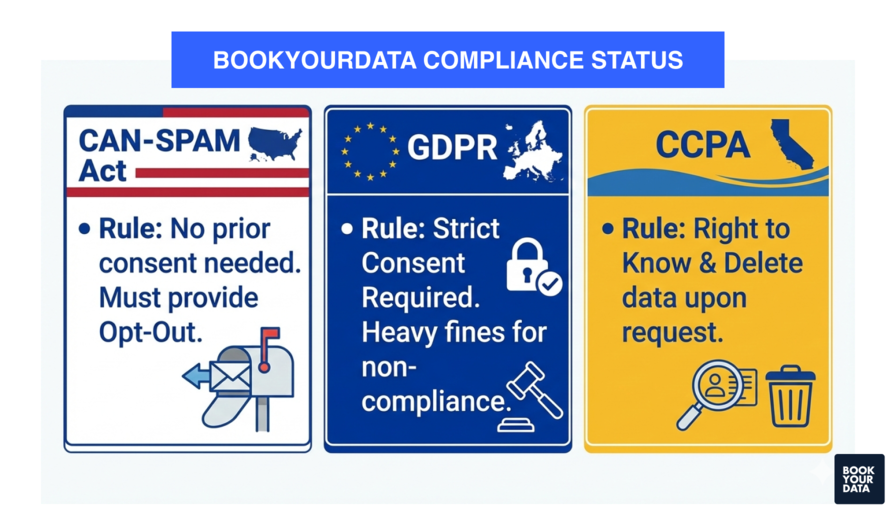
Buyers can ensure compliance when purchasing email marketing lists by selecting a reputable email list provider, checking the legitimacy of the email list, updating and cleansing the email list, customizing email content to the purchased list, including clear opt-out and unsubscribe options, and monitoring and responding to feedback.
Select a Reputable Email List Provider
Buyers should choose email list providers that follow strict data collection practices and comply with laws like GDPR, CCPA, and CAN-SPAM. A reputable provider maintains transparent sourcing methods and offers verified, accurate contact data. For example, BookYourData emphasizes ethical data practices and compliance, also offers a 97% accuracy guarantee, and regularly updates its database to maintain data quality.
Check the Legitimacy of the Email List
Businesses must verify that contacts on purchased lists have given some form of consent to receive marketing communications. The buyer should ask the provider about data sourcing methods and whether opt-in practices were used. Lists containing contacts who never agreed to receive emails can lead to spam complaints and legal violations. Legitimate lists come with documentation that shows when and how data has been collected.
Update and Cleanse the Email List
Regular list cleaning removes invalid, inactive, or outdated email addresses that can harm deliverability and sender reputation. Businesses should use email verification tools to identify bounced addresses, spam traps, and duplicate entries before launching campaigns. Maintain a clean mailing list free from inactive or incorrect emails to avoid potential legal issues.
Customize Email Content to the Purchased List
Marketers should customize email messages to match the interests and characteristics of contacts on purchased lists. Generic mass emails often trigger spam filters and lead to low engagement rates. Businesses can divide contacts by industry, job title, or location to deliver relevant content. Personalized subject lines and messaging show recipients that the sender understands their needs, which builds trust and improves response rates.
Include Clear Opt-Out and Unsubscribe Options
The CAN-SPAM Act requires businesses to tell recipients how to opt out of receiving future marketing emails and honor opt-out requests within 10 business days. Every marketing email must contain a visible unsubscribe link that works properly. Businesses should use direct wording like "unsubscribe from all emails" and place the link in a location users expect.
Monitor and Respond to Feedback
Businesses should track metrics like spam complaints, bounce rates, and unsubscribe rates to identify potential compliance issues early. Conducting an email marketing compliance audit ensures marketing practices, data collection, and retention methods align with federal and international regulations. Quick responses to negative feedback and removal requests demonstrate respect for recipient preferences.
What are the benefits of purchasing email lists?
The benefits of purchasing email lists include access to a relevant and targeted audience, quickly expanding your reach, increasing brand awareness and visibility, and improving lead generation efforts.
The benefits of purchasing email lists are listed below.
- Access to a relevant and targeted audience: Businesses get a professionally examined list of contacts who will respond to their marketing messages when purchasing emails from a reputable provider. This creates connections with prospects who match specific buyer personas.
- Quickly expand your reach: A new contact list increases the reach of campaigns and captures new potential audiences. Purchasing a large list of contacts immediately expands the database and is one of the fastest ways to grow potential leads.
- Increase brand awareness and visibility: Purchased email lists provide a unique opportunity to widen the audience and boost brand visibility. More people receive marketing messages, which helps establish brand recognition across new market segments.
- Improve lead generation efforts: Emailing contacts who already have a genuine interest in products and services accelerates lead generation and rate of return, which means that businesses see profits faster.
- Targeted prospects: A purchased list of B2B prospects improved through demographic appends and data enrichment techniques allows highly targeted outreach and makes sure that content is relevant to the B2B contact lists.
- Save time and resources: Buying an email list helps businesses continue the work when waiting for organic list growth is not feasible. Teams avoid months of manual prospecting and focus efforts on conversion strategies instead.
What risks should buyers be aware of when purchasing email lists?
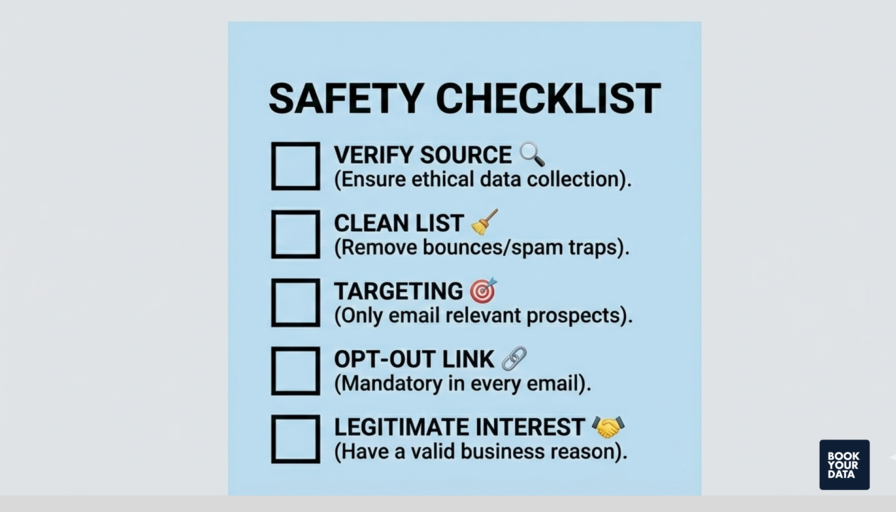
The risks buyers should be aware of when purchasing email lists include making low prices their main USP, lack of segmentation, sourcing from untrusted providers, unverified or outdated email addresses, and non-compliance with legal regulations.
The risks buyers should be aware of when purchasing email lists are listed below.
- Making low prices their main USP: Vendors offering extremely cheap email lists often compromise on data quality and accuracy. Traditional lists are known for outdated and inaccurate email data, which leads to high bounce rates and low email deliverability.
- Lack of segmentation: Purchased email lists do not allow effective message personalization. Generic lists without proper segmentation by industry, job title, or location result in irrelevant outreach and poor engagement rates.
- Sourcing from untrusted providers: Brokers often acquire data from other vendors, recycling the same contacts across platforms, which makes it impossible to verify origin, consent, or accuracy. Some lists contain fake or scraped addresses and lead to fraudulent transactions.
- Unverified or outdated email addresses: Purchased lists often contain addresses that are no longer in use by their owners, as they may have changed service providers or abandoned these email accounts. They often contain outdated or fake addresses and lead to high bounce rates.
- Non-compliance with legal regulations: Violating GDPR or CPRA can result in significant fines and lawsuits, and fines under GDPR can reach up to 4% of a company's global annual turnover or €20 million, whichever is higher. Unreliable email list sellers do not take compliance with laws seriously and collect personal information without consent.
Comparison table of benefits and risks of buying an email list
Here is a comparison table of the benefits and risks of buying an email list from a vendor or an authorized source.
What are the factors that businesses should consider when purchasing email lists?
The factors that businesses should consider when purchasing email lists include compliance with data privacy laws, user reviews, quality of the emails, pricing, ease of use, additional features, integrations, and filtering options.
Compliance with data privacy laws
Reputable email list providers follow data protection regulations like GDPR, CAN-SPAM, and CCPA. Businesses should verify that providers collect data ethically and obtain proper consent from contacts. Non-compliant lists can result in hefty fines and legal consequences, so request documentation that shows how the provider sources and validates their contact information.
User reviews
Customer reviews and testimonials reveal the real experiences of other buyers. Businesses should check independent review platforms and case studies before making a purchase. Positive feedback about data accuracy, customer support, and deliverability rates indicates a trustworthy provider. Negative reviews highlighting bounced emails or outdated contacts serve as warning signs to avoid.
Quality of the emails
High-quality email lists contain verified, active, and deliverable addresses. Providers should perform email address verification, which includes syntax verification, domain validation, and SMTP confirmation. Businesses must request accuracy guarantees and sample data before committing to a purchase. Poor-quality lists lead to high bounce rates, damaged sender reputation, and wasted marketing budgets. BookYourData has an 8-step email verification process and offers triple-verified data.
Pricing
Email list pricing varies based on list size, data quality, and customization options. Businesses should compare costs across multiple providers and avoid vendors offering suspiciously low prices to check email lists worth as cheap lists often contain outdated or recycled data. Premium lists that target specific industries or executive-level contacts cost more but deliver better results.
Ease of use
User-friendly platforms allow businesses to search, filter, and export contacts without technical expertise. The interface should be user-friendly with clear navigation and straightforward download options. Providers offering simple onboarding processes and helpful tutorials save valuable time. Complex systems with steep learning curves can delay campaign launches and frustrate marketing teams.
Additional features
Top providers offer extra services beyond basic email addresses. These features include real-time verification, data enrichment, intent data, bulk email verifier and technographic information. Some providers add phone numbers, social media profiles, and company details to improve outreach efforts. Businesses should evaluate which additional features match their marketing goals and sales strategies. BookYourData provides real-time verification, email addresses, direct dials, and technographic data with more than 100 data points.
Integrations
Smooth integration with existing tools simplifies workflow and minimizes manual data entry. Businesses should confirm that providers connect with popular CRM systems like Salesforce, HubSpot, and Zoho and offer API integrations. Integration with email marketing platforms such as Mailchimp and Constant Contact allows direct campaign deployment.
Filtering options
Advanced filtering options allow precise audience targeting based on specific criteria. Businesses should look for filters covering job titles, industries, company size, revenue, location, and technology usage. Granular filtering guarantees that marketing messages reach the most relevant decision-makers. Email list providers that offer 50 more filter options deliver better targeting capabilities for customized outreach campaigns. BookYourData offers more than 100 filters, like company size, location, revenue, and employees, to build lists that align with your goals.
How to buy a quality email list?
To buy a quality email list, consider factors such as determining your needs, researching providers, verifying the source, checking compliance, requesting a sample, assessing segmentation options, and confirming the list is up-to-date.
The ways to buy a quality email list are listed below.
- Determine your needs: Define your target audience before purchasing. Identify the industries, job titles, company sizes, and geographic locations that match your ideal customer profile.
- Research providers: Compare multiple email list vendors and read customer reviews. Look for providers with proven track records, positive testimonials, and transparent business practices to get verified email lists.
- Verify the source: Ask providers how they collect and validate their data using an email verification tool. Reputable vendors use ethical sourcing methods and can explain their data acquisition processes clearly.
- Check compliance: Confirm the provider follows GDPR, CAN-SPAM, and CCPA regulations. Request documentation showing proper consent collection and data handling procedures.
- Request a sample: Test a small portion of the list before committing to a full purchase. Evaluate deliverability rates, accuracy, and contact relevance through the sample data.
- Assess segmentation options: Review the available filtering criteria. Quality providers offer multiple filters, such as job function, industry, revenue, employee count, and location, for precise targeting.
- Confirm the list is up-to-date: Verify when the data was last validated. Quality providers refresh their databases regularly and guarantee high accuracy rates to minimize bounce rates.
What are the best practices to effectively build a targeted email list?
The best practices to effectively build a targeted email list include converting website visitors into subscribers and engaging and converting social media followers. Offering opt-in opportunities at the point of purchase, requesting email referrals from existing contacts, paid social media campaigns to gain subscribers, and gathering email addresses from offline events.
The best practices to effectively build a targeted email list are listed below.
- Convert website visitors into subscribers: Place opt-in forms strategically on high-traffic pages. Offer valuable incentives like ebooks, discounts, or exclusive content to encourage visitors to share their email addresses.
- Engage and convert social media followers: Direct your social media audience toward email signup pages. Share compelling content and promote lead magnets through posts that encourage followers to join your mailing list.
- Offer opt-in opportunities at the point of purchase: Capture customer emails during checkout by adding subscription checkboxes. Customers who complete purchases show genuine interest and become highly engaged subscribers.
- Request email referrals from existing contacts: Ask satisfied subscribers to recommend your newsletter to friends and colleagues. Referral programs with rewards for both parties generate quality leads from trusted recommendations.
- Paid social media campaigns to gain subscribers: Run targeted ads on Facebook, LinkedIn, and Instagram to reach specific audiences. Lead generation ads collect email addresses directly within the platform for seamless subscriber acquisition.
- Gather email addresses from offline events: Collect contact information at trade shows, conferences, and networking events. Use signup sheets, business card exchanges, or QR codes that link to your subscription forms.
What are the alternatives to buying email lists?
The alternatives to buying email lists include practicing consent-based email list building, setting up a double opt-in subscription process, offering an incentive, providing value in your emails, content marketing and lead magnets, LinkedIn outreach, and newsletter signups.
The alternatives to buying email lists are listed below.
- Practice consent-based email list building: Build your list organically by collecting addresses from people who genuinely want to hear from you. Consent-based subscribers show higher engagement rates and lower spam complaints.
- Set up a double opt-in subscription process: Require new subscribers to confirm their email address through a verification link. Double opt-in ensures valid addresses and demonstrates genuine interest in your content.
- Offer an incentive: Provide valuable rewards like discount codes, free trials, or exclusive access in exchange for email signups. Attractive incentives motivate visitors to share their contact information willingly.
- Provide value in your emails: Deliver helpful, relevant content that solves problems for your audience. Subscribers who receive consistent value stay engaged and recommend your emails to others.
- Content marketing and lead magnets: Create ebooks, whitepapers, templates, and guides that require email submission to download. Quality lead magnets attract prospects genuinely interested in your expertise.
- LinkedIn outreach: Connect with professionals in your target market and build relationships. Direct conversations can lead to permission-based email exchanges with qualified prospects.
- Newsletter signups: Promote your newsletter across your website, blog, and social channels. Highlight the benefits subscribers receive to encourage voluntary signups.
What makes BookYourData a reliable source for email lists?

BookYourData is a reliable source for email lists as it delivers real-time verified sales leads with a 97% accuracy guarantee. The business intelligence platform uses an advanced email verification process that filters out invalid or outdated addresses through an eight-step real-time system where each email is validated before export. The B2B platform BookYourData offers access to more than 500 million profiles and over 250 million business contacts across 200+ countries.
BookYourData allows you to build targeted B2B email lists using over 100 filters such as job title, industry, geography, company size, and technology usage. Every record in the database is triple-verified, which guarantees high deliverability rates and reliable outreach performance.
The pay-as-you-go model allows you to purchase exactly what you need for your marketing campaigns without expensive subscriptions. Credits never expire, which gives flexibility to use them at your own pace, and whenever data does not meet the 97% accuracy guarantee, the customer relations team will credit your account with free credits. The platform also integrates smoothly with major CRM systems like Salesforce, HubSpot, and Pipedrive for efficient data management.
Why should you verify email addresses?
You should verify email addresses to make sure your messages reach valid and active inboxes. Verification reduces bounce rates, protects your sender reputation, and prevents blacklisting by email service providers. Clean email lists improve deliverability, boost engagement rates, and maximize your marketing ROI. Verified email verification also helps maintain compliance with regulations like GDPR and CAN-SPAM.
What are the best practices for writing perfect and effective cold emails?
The best practices for writing perfect and effective cold emails are to write appealing subject lines that attract attention and personalize your message for each recipient. The cold email best practices also include keeping your content short, clear, and focused on the reader's needs. Include a strong call-to-action and provide clear value. Follow up consistently and test different approaches to improve response rates.
How to verify an email address without actually sending an email?
You can verify email addresses without sending an email through syntax checks that confirm proper formatting and domain validation that confirms that the domain exists. SMTP (Simple Mail Transfer Protocol) verification connects with mail servers to confirm mailbox existence without delivering messages. Email verification tools perform these checks automatically, verify email addresses without sending email, and detect spam traps, role-based addresses, and inactive accounts instantly.
What are the best free email list providers?
The best free email list provider is BookYourData, which offers 10 free leads with no subscription or credit card requirement. Apollo.io offers a free plan with 100 credits per month, Snov.io provides 50 free credits, while UpLead offers a free 7-day trial with 5 credits.
Which B2B email list providers offer high-quality lists?
The B2B email list providers that offer high-quality lists include BookYourData, which offers a 97% accuracy rate with real-time verification and a pay-as-you-go pricing model. Cognism offers high-quality B2B data that complies with GDPR and CCPA privacy laws. Other B2B email list providers include Data Axle USA, ZoomInfo, Lusha, and Apollo.io.
Which platforms offer the best email lists for purchase?
The platforms that offer the best email lists for purchase include BookYourData, which offers triple-verified email lists with firmographic and technographic insights. ZoomInfo is suitable for large B2B sales teams prospecting in multiple regions with high-quality data to buy email lists. Lusha offers a Chrome extension that generates contact information such as email addresses and phone numbers. Cognism and Apollo.io also provide reliable and verified business contacts.
How much does it cost to buy an email list?
The cost to buy an email list is around $100 to $400 for every 1000 emails for user-focused lists. Business email list pricing ranges from $500 to $1000+ for every 1000 emails. BookYourData uses a pay-as-you-go model with tiered pricing where costs per contact reduce for higher volumes, starting from $99 for 250 credits at $0.40 per contact,
$299 for 1,000 credits at $0.30 per contact, to $999 for 10,000 credits at $0.10 per contact, and even lower prices for higher credits.
Is buying an email list worth it?
Yes, buying an email list is worth it when you purchase from reputable providers that offer verified and accurate data. Quality lists save time, expand reach quickly, and accelerate lead generation efforts, but cheap or unverified lists waste marketing budgets and damage sender reputation. So always choose providers with accuracy guarantees, compliance certifications, and positive customer reviews.
How to legally obtain email addresses for free online?
You can legally collect email addresses by adding opt-in forms to your website and offering valuable lead magnets like ebooks or discounts. Social media platforms help convert followers into subscribers, and LinkedIn allows direct outreach to prospects. Webinars require registration with contact details, and referral programs encourage existing contacts to share your brand with others.
[CTA1]