Email List Pricing in 2026: A Complete Guide To Find the True Value Of Your Data
An email list is a group of subscribers, usually the people who have opted in, to receive updates, newsletters, or promotional emails. Email lists work by collecting subscribers through sign-up forms, then using email marketing tools to organize, segment, and send targeted emails to the relevant and engaged audience.
The cost of a consumer email list ranges from $100 to $400 CPM (Cost Per Mille), while B2B email lists cost between $300 to over $1,000 per thousand addresses. The legality of buying an email list depends on the geographic region, as local data protection and privacy laws differ from country to country. It is important to comply with GDPR (General Data Protection Regulation) and the CAN-SPAM Act of 2003 when purchasing an email list.
Buying an email list offers many benefits, such as saving time, reducing costs, helping reach new markets, improving targeting and segmentation, and increasing conversion rates. But it also comes with various challenges like invalid email addresses, an irrelevant target audience, fines, poor email list quality, and potential reputational risk. So it is important to carefully consider an email list provider before buying a valuable email list.
What is the cost of an email list?
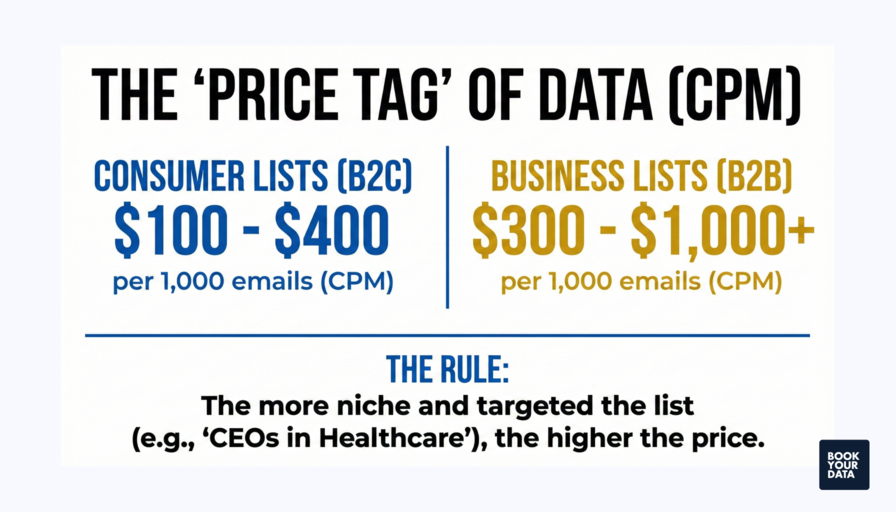
The cost of an email list depends on factors such as the quantity, source, quality of the emails, and the target audience type. Email list prices are often based on CPM (Cost Per Mille), which means cost per thousand impressions. Consumer email lists cost between $100 and $400 CPM, while B2B (Business-to-Business) email lists are more expensive, ranging from $300 to over $1,000 per thousand addresses. The more targeted and specialized the email list is, the higher the price. The cost of an email list also differs from one provider to another based on factors like list freshness, accuracy, engagement rates, and audience demographics.
Comparison table of email list providers
Below is the comparison table of email list providers, which includes BookYourData, UpLead, Cognism, Lead411, ZoomInfo, Lusha, Adapt.io, RocketReach, Data Axle USA, D&B Hoovers, Apollo.io, and Salesgenie.
The above table offers a comprehensive comparison of each email list provider’s capabilities based on features, pricing, and G2 ratings. User ratings provide further insight into overall satisfaction, reliability, and the quality of service to understand the practical value each provider delivers.
Is buying an email list legal?
Whether buying an email list is legal or not depends on the geographic region, which means its legality differs from country to country based on local data protection and privacy laws. Selling and buying an email list is allowed in the United States, but it is important to comply with the CAN-SPAM Act of 2003. Marketing emails should only be sent to contacts who have opted in and provided clear permission. It is important to maintain a transparent unsubscribe mechanism and comply with any opt-out requests.
Using up-to-date, valid, and clean email data helps prevent high bounce rates and spam complaints. Implementing a permission-based list-building approach, rather than purchasing lists, maintains compliance with privacy and anti-spam laws. The GDPR (General Data Protection Regulation) places strict limitations on the use and sale of email lists in Europe to fulfill compliance requirements and user consent. Renting an email list is legal in Europe if the owner has permission from the leads to promote content from a third party.
Are email lists worth it?
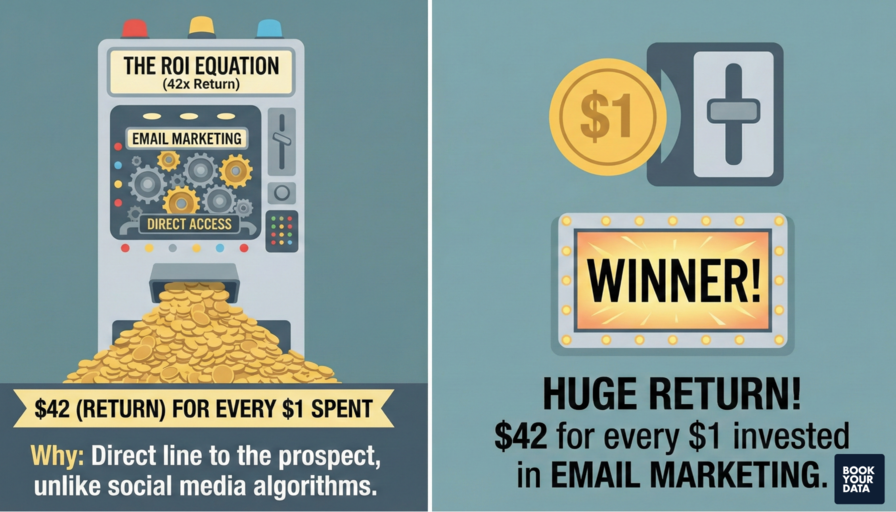
Yes, email lists are worth it, but the value depends on how they are built and used. Using email marketing through an email list delivers an impressive return. Email marketing earns $42 for every $1 spent, which is a 42x ROI (Return on Investment), according to the article titled “Email marketing has potential ROI of $42 for every dollar spent” by Financial Post, which quoted Forbes. Email lists are worth it if you invest in good list-building practices, such as opt-in, value exchange, segmentation, and relevance, and use the list smartly with good content and targeting. The ROI is less likely to match the above report numbers if you simply buy large lists from list brokers and send generic emails. Small businesses also build their own email list of opted-in, qualified leads instead of buying an email list.
How to build an email list organically for more engagement?
To build an email list organically for more engagement, create high-value lead magnets, include sign-up links, use QR codes, add newsletter pop-ups or forms, offer incentives, and simplify the subscription process.
The ways to build an email list organically for more engagement are listed below.
- Create high-value lead magnets: Offer users something useful, like a checklist, cheat sheet, eBook, or template, in exchange for an email address. Users are more likely to subscribe if the freebie quickly solves a specific problem they have.
- Include sign-up links: Make sure subscription links or buttons are easy to find and use in email signatures, social media, and blog posts. Visibility and easy access increase conversions.
- User QR codes: A QR code takes users directly to your opt-in or signup page when working offline, like at events, on packaging, or on print materials, which makes the process smooth and quick.
- Add newsletter pop-ups or forms: Integrate pop-ups, such as timed, scroll-responsive, or exit-intent, or attached sign-up forms into your website to capture visitors before they leave without subscribing.
- Offer incentives: Give special discounts, exclusive content, or early access as a reward for subscribing, along with lead magnets. These incentives increase the estimated value, so users are influenced to opt in.
- Simplify the subscription process: Keep the form short, often just an email address, clearly explain the value of subscribing, and avoid unnecessary fields or interruptions. A smooth subscription process means higher conversion and fewer drop-offs.
How to maintain a healthy email list for effective marketing campaigns?
To maintain a healthy email list for effective marketing campaigns, use targeted messaging and CTAs (Call to Action), set clear expectations on your sign-up page, clean your list regularly, be transparent, provide an opt-out option, send clear and concise messages, and respect subscriber privacy.
The ways to maintain a healthy email list for effective marketing campaigns are mentioned below.
- Use targeted messaging and CTAs: Send customized content to specific segments based on their interests or behavior, and include a clear action you want them to take.
- Set clear expectations on your sign-up page: Inform new subscribers about the type and frequency of content they are to receive, along with the value it provides, to provide clarity and manage expectations.
- Clean your list regularly: Remove invalid or inactive addresses, segment unengaged subscribers, and verify email authenticity to keep your list healthy with strong deliverability.
- Be transparent: Clearly communicate the purpose of your emails, explain how subscriber data is utilized, and provide accessible options for managing preferences or unsubscribing.
- Provide an opt-out option: Always include a clear and easily accessible unsubscribe or pause link so subscribers can exit or adjust their involvement without any complexity.
- Send clear and concise messages: Focus on relevance, keep the message highly focused, include a clear CTA, and avoid sending unnecessary or overly long content.
- Respect subscriber privacy: Handle subscriber data responsibly by not sharing or misusing it. Receive proper consent and comply fully with all applicable data protection regulations, like GDPR (General Data Protection Regulation).
What are the benefits of buying an email list?
The benefits of buying an email list include saving time, reduced costs, reaching new markets, increasing your brand visibility, improved targeting and segmentation, and increased conversion rates.
The benefits of buying an email list are outlined below.
- Save time: Purchasing a list provides ready‑to‑use contacts so you can begin outreach instantly without the time-consuming process of building a list from scratch.
- Reduced costs: Buying a targeted list lowers upfront effort and cost compared to many traditional lead‑generation methods. This approach of purchasing targeted lists allows for faster campaigns and possibly higher ROI (return on investment).
- Reach new markets: A purchased list also provides access to a larger or different set of contacts, for example, in new regions, industries, or demographics, than your current organic list includes.
- Increasing your brand visibility: Buying an email list expands opportunities by exposing a larger number of contacts to your brand. These opportunities also keep your business visible to potential customers.
- Improved targeting and segmentation: Some high‑quality purchased lists are pre‑segmented by industry, job title, demographics, or behavior, which helps you direct more relevant messages to subsets of the list.
- Increased conversion rates: A purchased list that closely matches your offerings generates faster conversions from leads to customers. It effectively utilizes a wide range of potential prospects when combined with targeted messaging or through lead generation specialists.
What are the challenges of buying an email list?
The challenges of buying an email list are invalid emails, an irrelevant target audience, fines, poor email list quality, possible reputation risk, and no guarantee of a strong ROI (Return on Investment).
The challenges of buying an email list are listed below.
- Invalid emails: Purchased email lists often include outdated, incorrect, or inactive addresses. These outdated email lists result in high bounce rates, which damage your sender reputation and reduce overall email deliverability.
- Irrelevant target audience: Sending emails to contacts who did not opt in or do not match your ideal customer profile may result in low engagement and wasted effort, as the messages are unlikely to connect with the target audience.
- Fines: Buying an email list sometimes involves contacts who have not given proper consent, which violates privacy and anti‑spam laws, such as GDPR (General Data Protection Regulation) and the CAN‑SPAM Act. Such privacy violations result in costly financial penalties for the buyer.
- Poor email list quality: Many purchased listings include duplicate entries, spam trap addresses, or contacts who have no interest in your offers. This poor quality of the email list leads to ineffective campaigns and wasted budget.
- Possible reputation risk: Sending unsolicited emails causes recipients to mark your messages as spam, damage trust in your brand, and degrade your sender reputation, which makes future campaigns less effective.
- No guarantee of a strong ROI: The issues of poor quality, low engagement, and compliance risks often cause purchased email lists to produce low open and click rates, along with lower conversions. These issues related to buying an email list reduce the expected return on investment.
Comparison of the benefits and challenges of buying an email list
What are the factors that determine the value of an email list?
The factors that determine the value of an email list are the quality of email addresses, list size, opt-in method, list cleanliness, and demographics.
The factors that determine the value of an email list are listed below.
- Quality of email addresses: Businesses must assess email address quality by ensuring contacts are accurate, active, and engaged. A high-quality list, sourced from a reliable B2B contact database or collected organically, includes real, verified, opted-in subscribers who show interest, which results in better deliverability, open rates, and conversions.
- List size: The size of an email list affects potential reach and lead volume. Larger lists offer more opportunities, but they must be balanced with quality because a big list with disengaged contacts reduces deliverability and wastes resources. Increased value comes from balancing size and quality.
- Opt-in method: The methods used to add subscribers to the email list also assess its value. Double opt-in lists confirm consent, improve data accuracy, and reduce spam complaints. Lists without proper opt-in methods or accessed through list-building services involve compliance risks and lead to lower engagement.
- List cleanliness: Regularly cleaning your email list is necessary to maintain value. Email list cleaning includes removing invalid, inactive, or bounced email addresses frequently to protect deliverability and engagement. A clean list reduces hard bounces and spam complaints, improving sender reputation and overall email marketing effectiveness.
- Demographics: The email list’s data should match your target audience with accurate and relevant demographic details, such as industry, job role, or location. Accurate demographic data allows effective segmentation, creating customized messaging that leads to more personalized campaigns, stronger engagement, and higher conversion rates.
How to calculate the value of your email list?

To calculate the value of your email list, determine the twelve-month list revenue, subtract costs from revenue to find the net, find the total number of active subscribers, and divide net revenue by active subscribers.
Determine the total revenue generated from the email list over the last twelve months, which includes all sales or conversions related to email campaigns sent to the list.
Subtract all relevant costs connected to the email list during the twelve months from the revenue, such as email platform fees, content creation, list management, and other marketing expenses, which gives you the net revenue (profit) from your email list.
Identify the total number of active subscribers in your list. Active subscribers are those who have engaged with your emails recently or have not unsubscribed or bounced.
Divide the net revenue by the number of active subscribers to find the average value per subscriber and calculate the value of your email list.
Why is it important to understand the value of your email list?
It is important to understand the value of your email list, as it provides an opportunity to collect accurate data about your customers, like their age, location, interests, and purchasing behavior. It also helps you make informed decisions about your email marketing investments and strategies.
What is the rate for the average email list?
The rate for the average email list is generally $100 to $600. This rate is for 1,000 emails, but it also depends on the quality and segmentation of your email list.
Which bulk email verifiers offer the most accurate results for marketers?
The bulk email verifiers that offer the most accurate results for marketers include BookYourData, Bouncer, ZeroBounce, MillionVerifier, and Clearout. BookYourData offers 97% data accuracy for large lists, credits that never expire, and supports integration with major email and CRM platforms.
What are the best places to buy email lists?
The best places to buy email lists are BookYourData, Lead411, Lusha, ZoomInfo, Cognism, UpLead, Hunter.io, Apollo.io, D&B Hoovers, Seamless.AI, and Adapt.io.

How to get bulk email addresses for free?
To get bulk email addresses for free, use tools like GetProspect, Hunter.io, and Snov.io to upload names or domains and extract business emails. You can also create valuable lead magnets or integrate sign-up forms on your website to collect opt-in addresses.
How to find someone’s email address using just their name?
To find someone’s email address using just their name, use Google, LinkedIn, or WHOIS records, as they show their email address. Try email finder tools, such as GetProspect and Hunter.io, or guess common email formats and verify them. Always use publicly available information and respect privacy laws, like GDPR (General Data Protection Regulation).
Should you buy email lists to get new customers?
Buying email lists to get new customers is generally risky because the recipients often have not given explicit consent. This risk violates privacy and anti-spam laws, damages your sender reputation, and leads to low engagement.
How does an email list support B2B lead generation efforts?
An email list supports B2B lead generation efforts by providing direct access to qualified decision-makers, which allows personalized and segmented outreach that improves engagement and conversion rates. It nurtures leads through targeted content, improves brand awareness, and offers a high ROI (Return on Investment) with measurable campaign performance.
Which B2B email list providers offer verified and compliant contact data?
B2B email list providers that offer verified and compliant contact data are BookYourData, ZoomInfo, Cognism, Hunter.io, Lusha, Seamless.AI, Lead411, and Datanyze. B2B email list providers also include RocketReach, UpLead, 6sense, and Adapt.io.
[CTA1]

.png)