How To Generate High-Quality Email Leads in 2026: 22 Effective Strategies
Email leads are prospective customers’ email addresses, collected with their consent through web opt-ins or through verified B2B data sources. These leads also include other contact information such as names, job type, and company.
Email lead generation is the process of capturing and nurturing those contacts as potential customers using targeted content or outreach. This lead generation is important for sales and marketing because it creates a direct, cost-effective channel to prospects and supports segmentation, personalization, and measurable ROI.
Below is the table of strategies that help generate high-quality email leads, such as identifying ICP (Ideal Customer Profile), creating high-value lead magnets and gated content, including a double opt-in process for verification, and utilizing referrals from existing subscribers.
The strategies to generate high-quality email leads include identifying your ideal customer profile, creating high-value lead magnets and gated content, designing simple and user-friendly opt-in forms, building credibility and social proof, and delivering valuable and relevant content. These effective strategies make sure that your list is relevant and engaged, which improves conversion rates and long-term customer relationships.
The 22 proven and effective strategies to generate high-quality email leads are listed below.
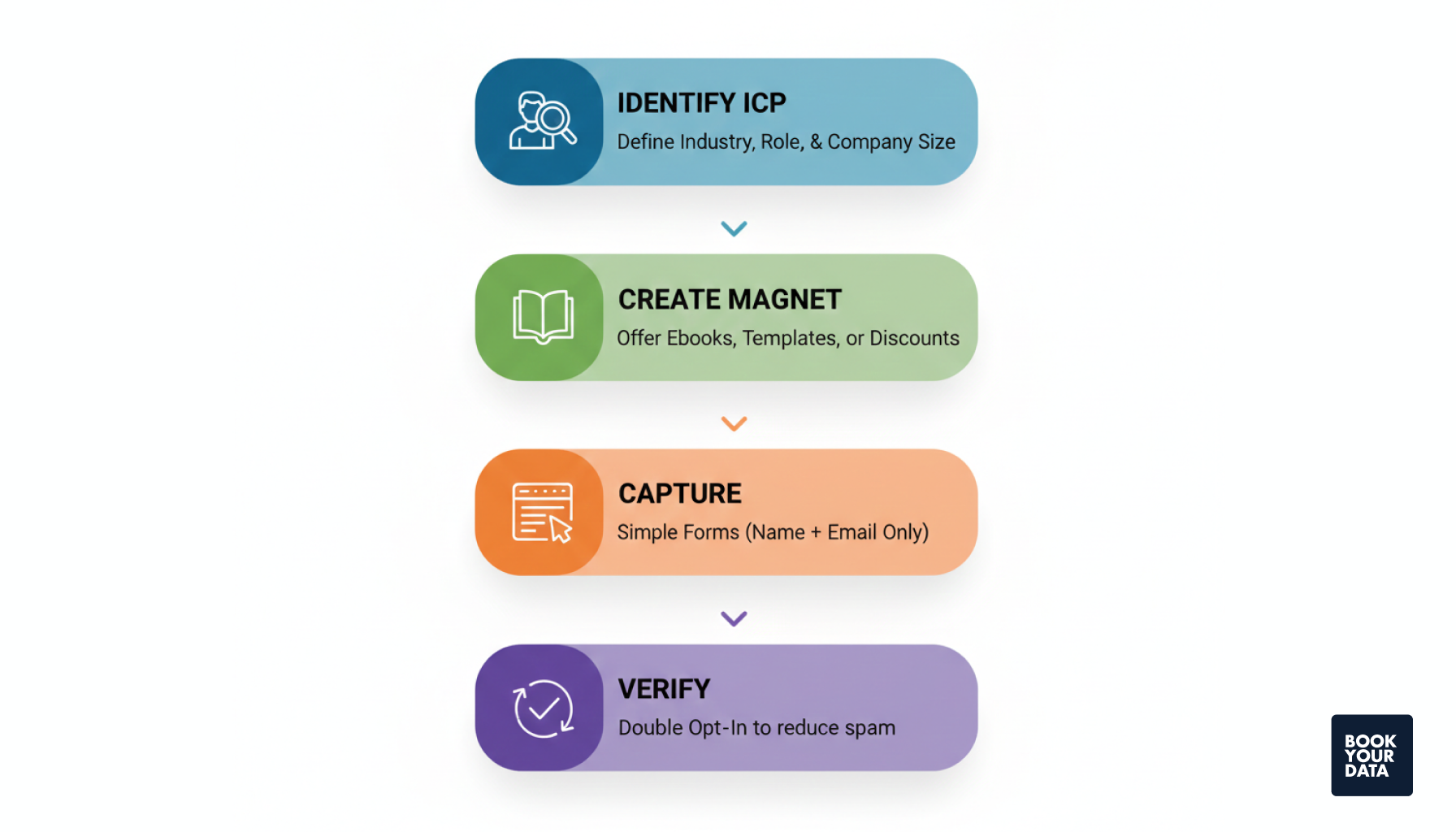
- Identify your ideal customer profile: Analyze current clients to identify patterns in industry, company size, and job role to target prospects most likely to convert.
- Create high-value lead magnets and gated content: Offer useful resources like eBooks, checklists, or reports that solve specific problems to attract interested leads.
- Design simple and user-friendly opt-in forms: Keep forms simple, just email or name, to reduce complexities and increase sign-ups.
- Include a double opt-in process for verification: Require email confirmation to confirm valid addresses and build a clean, verified list.
- Offer multiple opt-in opportunities: Place opt-ins at strategic points of interaction, which include pages, blog posts, and pop-ups, to monitor different visitor behaviors.
- Build credibility and social proof: Show testimonials, download counts, or trust statistics to increase sign-up conversion.
- Write engaging headlines, subject lines, and copy: Use clear headlines that offer incentives and action-focused CTAs to increase conversions and engagement.
- Deliver valuable and relevant content: Make sure your content matches audience needs and offers real value to maintain interest and trust.
- Use exclusive incentives for new leads: Offer special benefits like discounts or early access to motivate sign-ups and attract high-intent prospects.
- Introduce interactive formats: Use interactive content like webinars or surveys to engage more leads and qualify interest.
- Implement automated email campaigns: Follow up immediately after sign-up with nurture sequences to build relationships and guide leads toward conversion.
- Apply lead scoring to focus on potential leads: Segment and rank leads by behavior or firmographics to focus efforts on those most likely to convert.
- Conduct A/B testing: Test different headlines, forms, CTAs, and layouts to maximize conversion and continuously improve results.
- Implement prominent and persuasive CTAs: Integrate strategically positioned calls to action in visible areas to improve conversions.
- Clean up and maintain email list hygiene: Regularly remove invalid or inactive emails to maintain deliverability and list quality.
- Provide mobile-friendly designs and reliable deliverability practices: Make sure forms, content, and emails show well on mobile to reach users wherever they are.
- Utilize referrals from existing subscribers: Ask current subscribers to refer peers or colleagues, which builds trust and social networks to grow leads.
- Promote through social media: Use social channels to attract visitors to gated content or landing pages, which expands reach beyond organic visitors.
- Use dedicated landing pages for specific campaigns: Build organized pages with clear offers and fewer distractions to promote conversion from targeted campaigns.
- Improve follow-up interactions: Offer immediate value and guide next steps to establish trust and engagement after signups.
- Build partnerships and collaborations to reach new audiences: Collaborate with other brands or influencers to access new audiences and attract quality leads.
- Use waiting lists or pre-registration when launching new offerings: Create exclusivity and gather qualified leads before launch to build interest and promote engagement.
1. Identify your ideal customer profile
An ICP (Ideal Customer Profile) defines the qualities of prospects most likely to convert. B2B companies define their ICP by factors such as industry, company size, revenue, job titles, and geographic location. Creating an accurate ideal customer profile requires analyzing your existing customer base and looking for patterns in their job functions, industries, and company sizes, especially among your highest-value clients.

BookYourData is a lead generation tool that provides over 100 data attributes to help users filter contacts based on firmographics, technographics, and intent signals. Users are allowed to build highly targeted lists and reach the right prospects more effectively by using these verified data attributes.
2. Create high-value lead magnets and gated content
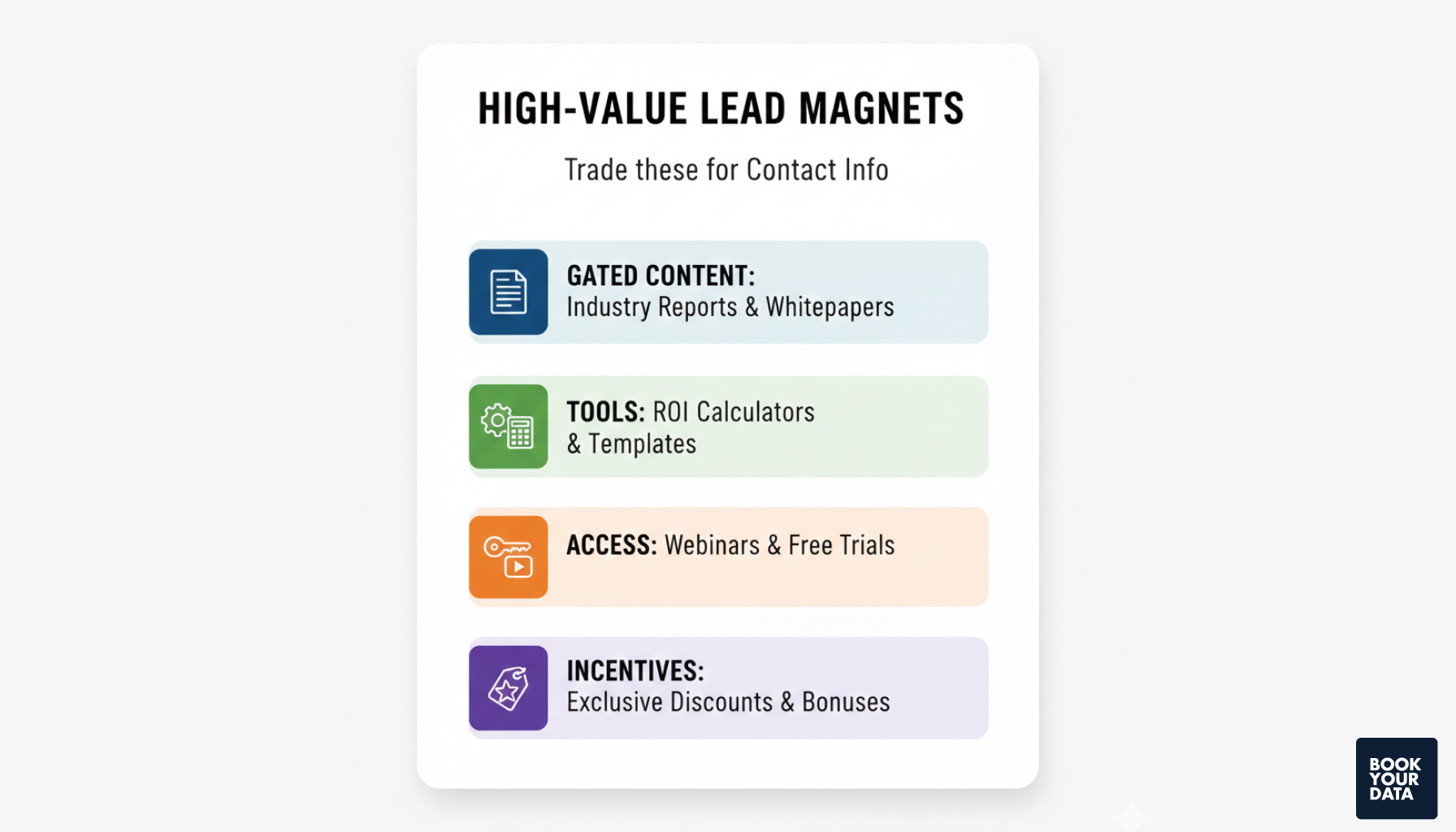
A lead magnet is a free resource, such as eBooks, industry reports, ROI calculators, templates, checklists, and case studies, offered in exchange for a prospect’s contact information. Effective lead magnets focus on a specific issue that your target audience faces. For example, B2B sales teams mostly download prospecting templates and objection-handling guides, while marketing managers interact with benchmark reports and campaign planning checklists.
Gated content is placed behind a sign-up form to make sure that only interested users provide their email address. Using an email verification tool after collecting these sign-ups helps maintain a clean, accurate list, attract high-intent prospects, and build a more qualified and engaged email base. Webinar registrations capture higher-intent leads than PDFs because attendees invest time, not just an email address.
3. Design simple and user-friendly opt-in forms
Design opt-in forms that request important information, such as name, email address, company size, or job title, but keep them simple and user-friendly because lengthy forms reduce conversion rates. Place forms where visitors already show interest, which include blog sidebars, end-of-article sections, and exit-intent pop-ups. Use clear, action-focused button text like “Get Your Free Guide” rather than generic options like “Submit.” Simplify the sign-up process for users by providing social sign-in options and allowing autofill for a quick and simple experience.
4. Include a double opt-in process for verification
Including a double opt-in process means asking subscribers to confirm their email address after they sign up. This extra step helps prevent fake entries, spam traps, and common typing mistakes. The process begins when a user enters an email, receives a confirmation message, and becomes part of your active list after clicking the verification link.
Double opt-in improves the quality of your audience and protects your sender reputation by reducing bounce rates. Email service providers monitor bounce rates and spam complaints, and a large number of invalid addresses also activate spam filters and lower deliverability. Using double opt-in helps keep your list clean and improves your chances of reaching the inbox consistently.
5. Offer multiple opt-in opportunities
Offering multiple places for users to sign up makes it easy to capture more emails. Add opt-in forms on dedicated landing pages, homepage banners, blog footers, sidebar sections, and pop-ups that show when someone is about to leave the page or after they have spent some time reading. These different entry points reach users at different stages and motivate them to subscribe. A focused landing page works well when it shows one offer and removes unnecessary distractions to keep visitors focused on the sign-up action.
6. Build credibility and social proof
Show testimonials, client logos, case study results, and review ratings of happy customers near your opt-in forms because social proof increases opt-in conversions. Trust badges from recognized organizations prove legitimacy, while video testimonials from recognizable industry figures also improve credibility. For instance, BookYourData maintains a 4.9-star rating on G2 from verified user reviews. User-generated content, such as social media mentions and customer success stories, builds authentic trust. Place these social proofs above the fold and close to your call-to-action buttons for maximum visibility.
7. Write engaging headlines, subject lines, and copy
Subject lines determine open rates, so keep them short, under 50 characters, and easy to read on mobile screens, as PersanaAI describes in the article titled “10 Cold Email Subject Lines That Actually Get Opened in 2025.” Use numbers and specifics to capture attention, for example, “5 Templates That Doubled Our Response Rate” is better than “Great Email Templates.” A follow-up email subject line should be just as clear and concise so recipients immediately understand the value.
Headlines on landing pages should state the benefit clearly to show the positive results users can expect, rather than just listing features. Keep body text brief, focus on possible objections, and provide value. Use short sentences and break long paragraphs into small blocks, while including strong action verbs and avoiding any filler words. Test different headlines to see which ones perform best and increase engagement.
8. Deliver valuable and relevant content
The quality of your content determines long-term engagement and conversion rates, so create content that matches subscriber intent. New subscribers need educational content that introduces them to your solution. Leads in the middle of the funnel respond well to comparison guides and case studies, while prospects at the final stage are more interested in demos, trials, and pricing details. Segment your email list by industry, role, and engagement level to send relevant insights to each group. Keep your content fresh and up-to-date, because outdated statistics or references affect credibility. Adding original research, proprietary data, and expert interviews makes your content unique and establishes your brand as a reliable authority.
9. Use exclusive incentives for new leads
Exclusive offers motivate sign-ups, which include percentage discounts, free shipping, bonus resources, early access to new features, and loyalty program enrollment. Limited-time offers create urgency, so users act more quickly, while first-purchase incentives help to reduce hesitation. For example, BookYourData gives new users free verified leads to test data quality before committing, which provides great value for customers who are indecisive about their purchase intent.
Make the exclusivity clear by using precise language such as “subscriber-only pricing” or “members-only access” to show the value of joining your list. Combining multiple incentives, like a discount, a free resource, and early access, makes the offer even more attractive.
10. Introduce interactive formats
Interactive content increases engagement more than static content, so including quizzes, assessments, surveys, and calculators captures high-quality leads while offering personalized value. Tools like a “Lead Generation ROI Calculator” or a “Sales Readiness Assessment” help to qualify leads and gather useful information.
Webinars are also highly effective for generating leads, and live Q&A sessions increase interaction and establish your brand as an authority. Following up after webinars converts a large number of attendees into qualified opportunities. Surveys also help to collect information about preferences, challenges, and goals, which is used to customize future communications by understanding their preferences and pain points to make them more relevant for each subscriber.
11. Implement automated email campaigns
Email automation allows you to nurture leads effectively without manual effort, as a welcome sequence introduces new subscribers to your brand, usually through three to five emails over two weeks that show your value and top content. Drip campaigns send emails based on user behavior, such as offering related content after an eBook download or a demo after visiting a pricing page.
Abandoned cart sequences help rebuild lost sales, while re-engagement campaigns target subscribers who have been inactive for some time. Segmenting your audience by engagement level and adjusting the frequency of emails makes sure your messages remain relevant and effective.
12. Apply lead scoring to focus on potential leads
Lead scoring assigns numerical values to prospects based on their behavior and engagement with your content to measure their possibility of conversion. Scores are based on actions such as email opens, link clicks, page visits, content downloads, and form submissions. Behavioral scores also track engagement, with repeated visits to pricing pages showing strong interest. Demographic factors, such as job title, company size, and industry, also influence the score. For example, a VP of Sales at a large company receives a higher score than an intern at a small agency.
High-scoring leads go directly to sales, mid-range leads receive nurturing emails, and low-scoring leads stay in educational campaigns until they show more interest. Lead scoring models should be reviewed and updated regularly to maintain accuracy.
13. Conduct A/B testing
A/B testing compares two versions of an email element to see which performs better. Test only one factor at a time, such as subject line, sender name, send time, call-to-action button, or layout. Run the test on a large group to get reliable results, and wait 24 to 48 hours before deciding the winner to account for different time zones and email practices, according to the article titled “Why Email A/B Testing Is Your Campaign’s Secret Weapon” by Nutshell. Keep a record of all results, as they help identify patterns and apply the most effective elements to all campaigns for better performance over time.
14. Implement prominent and persuasive CTAs
Call-to-action buttons improve conversions, and personalized CTAs perform much better than generic ones. Use phrases like "Start Your Free Trial," "Download the Guide," or "Get Your Custom Quote" that are simple and direct. Apply contrasting colors to design unique buttons, and make sure they are large enough for easy tapping on mobile devices.
Place CTAs near the top of the email and repeat them at the end, and add words that show a time limit to create urgency in users to act quickly. First-person language, like “Start My Free Trial,” also increases clicks.
15. Clean up and maintain email list hygiene
Keeping your email list clean directly affects deliverability and sender reputation, as email addresses become outdated after people change jobs or accounts. Remove hard bounces regularly and delete soft bounces that occur repeatedly. Identify subscribers who have not opened emails in over 90 days and send a re-engagement campaign before considering removal, and segment inactive contacts to reduce the frequency of the email. Regular list cleaning helps reduce spam complaints, improve open rates, and lower email platform costs.
Use email verification tools to check addresses before adding them to your list. B2B contact databases like BookYourData offer 97% accuracy and real-time verification to provide reliable contact data.
[CTA1]
16. Provide mobile-friendly designs and reliable deliverability practices
Most emails are opened on mobile devices, so use responsive templates that adjust to different screen sizes. Deliverability also depends on proper authentication, so set up SPF (Sender Policy Framework), DKIM (Domain Keys Identified Mail), and DMARC (Domain-based Message Authentication, Reporting, and Conformance) records for your sending domain. These authentications verify your identity and reduce the risk of spam.
Warm up new domains slowly by starting with a small number of emails and increasing daily over a few weeks. Monitor your sender reputation using tools like Google Postmaster and Microsoft SNDS, and avoid words causing spam or extra punctuation in subject lines.
17. Utilize referrals from existing subscribers
Referral programs turn subscribers into lead generators, as referred leads convert better and have high value. Provide incentives to both the referrer and the recipient, since double-sided incentives produce more referrals than one-sided programs. Rewards include account credits, free service months, exclusive content, or gift cards. Make sharing simple by providing pre-written social posts, email templates, and unique referral links. Track referrals accurately and show progress publicly, such as “Refer 3 friends, get a free month.” Adding interactive elements, like leaderboards, tiers, and milestone rewards, keeps top referrers engaged over time.
18. Promote through social media
Social media advertising generates targeted traffic to opt-in pages. LinkedIn Lead Gen Forms allow users to submit their email directly on the platform, while Facebook Lead Ads work well for B2C audiences. Retargeting campaigns reach visitors who left without subscribing and show ads across platforms like Facebook, Instagram, LinkedIn, and display networks. Retargeted visitors convert more frequently than new traffic. Similar audiences help find new prospects identical to your best customers, while uploading your email list allows you to create custom audiences for targeting or exclusion. Test different ad creatives, copy, and offers to improve cost per lead and overall campaign performance.
19. Use dedicated landing pages for specific campaigns
Campaign-specific landing pages convert much better than generic homepage sign-ups. Match the landing page content with the source of traffic, so visitors from a LinkedIn ad about sales prospecting see a page focused on that topic. Remove menus and links that distract visitors, and focus on a single call to action. Include a preview of the lead magnet, such as a cover image, table of contents, or sample pages, and add testimonials from people who used the resource successfully. Keep forms visible above the fold on desktop, and reduce scrolling on mobile. Fast-loading pages also perform better, as pages that load in under three seconds convert better than slower pages.
20. Improve follow-up interactions
Thank you pages provide immediate opportunities for marketing and engagement. Redirect users to a page that confirms their action and suggests a next step after a form is submitted. The next step suggestions include scheduling a demo, joining a webinar, following on social media, or downloading a related resource. Use the page to set expectations, for example, by telling users to check their inbox for the download link. Send confirmation emails within two minutes to prevent subscribers from forgetting or marking them as spam. Use a clear subject line by including one piece of bonus content or an exclusive tip rather than just a transactional message because the first email establishes the relationship.
21. Build partnerships and collaborations to reach new audiences
Build partnerships and collaborations to expand your reach and connect with new audiences. Working with complementary brands, influencers, or industry organizations allows you to share resources, co-create content, and access networks that are difficult to reach on your own. Well-planned collaborations increase visibility, credibility, and lead generation opportunities for both parties.
22. Use waiting lists or pre-registration when launching new offerings
Waiting lists gather potential customers before a product launch by advertising exclusivity and limited access. Messages like “Join 2,500 others waiting for early access” create social proof and increase sign-ups. Pre-registration pages collect emails from high-intent prospects, who mostly convert at higher rates than standard opt-ins. Countdown timers, such as “Launching in 14 days,” motivate action. Keep subscribers engaged with regular updates and offer exclusive benefits like early access, special pricing, or bonus features. Monitor how many waitlist members become customers to predict launch results, and organize leads by sign-up date to give them tiered access.
What are email leads?
Email leads are prospective leads who have shared their contact information, usually an email address, with your business through explicit consent. Potential clients fill out an opt-in form through an email search engine or on your website and, in exchange, receive a specific lead magnet such as a free ebook, checklist, template, webinar access, or discount code. They become email leads by providing details, like email address, company, or job title, and allowing you to engage with them through targeted email campaigns. This process helps businesses capture interested prospects, nurture relationships over time, and guide them toward making a purchase or taking another planned action.
How does the email lead process work?
The email lead process works by moving through acquisition, where a lead signs up, nurturing, where you stay in contact, conversion, where the lead completes the intended action, and retention, where you continue engaging them after that action.
The ways through which the email lead process works are listed below.
- Acquisition: Acquisition is the process of a lead signing up or entering your funnel via a signup form, advertisements, content, or social media, and providing you with their contact information, such as email.
- Nurturing: Nurturing is the stage where you stay in contact with the lead through useful emails and updates to build interest and trust. This stage requires planning what message each lead receives, based on where they are in their journey and what they need to decide. Not all leads are ready to buy immediately, so nurturing gives them time to consider, compare, and learn before making any commitment.
- Conversion: Conversion is the process by which the lead takes the intended action, such as making a purchase or registering for an offer. This process provides clear calls to action, which makes the buying process easy to follow.
- Retention: The retention process includes continuing to engage the customer through support, regular communication, value-added content, or follow-up offers. This engagement builds loyalty and suggests repeat engagement or purchase.
What are the types of email leads?
The types of email leads are cold leads, warm leads, and hot leads.
What is email lead generation?
Email lead generation is the process of collecting email addresses from people who have shown interest in a company’s products or services. These contacts are then used to send targeted emails that inform, update, or promote offerings to convert them into customers. Email lead generation works by offering something of value, such as a downloadable guide, newsletter subscription, discount, early access, or other lead magnet, in exchange for a visitor’s email address.
What are the examples of email lead generation?
The examples of email lead generation are listed below.
- Free tools or calculators: Free tools or calculators for email lead generation involve a return on investment calculator or a website-health checker.
- Template bundles or planners: Template bundles or planners include social‑media content calendars, email templates, and design or layout templates.
- Free consultations or estimates: Free consultations or estimates mean offering a no‑cost consultation, quote, or assessment in exchange for contact information.
Why is email lead generation important for sales and marketing?
Email lead generation is important for sales and marketing because it helps build a list of people who have already shown interest in their products or services and who actively consent to receive communications. The sales and marketing teams send prospects targeted, relevant messages, which makes communication more direct because these verified leads opted in voluntarily.
Email lead generation is a more cost-effective way to reach a large number of potential customers on a limited budget than many traditional marketing or advertising methods. It helps sales and marketing teams monitor metrics, like opens, clicks, conversions, and engagement, through the email lookup tool. Email lead generation also supports long-term relationships through regular and personalized communication, and sales and marketing teams nurture leads into loyal customers.
How to create an email for lead generation?
To create an email for lead generation, write engaging subject lines, keep the message concise, use visuals, integrate social media links, and include a clear and persuasive CTA.
The methods to create an email for lead generation are listed below.
- Write engaging subject lines: Write clear and engaging subject lines so the recipient wants to open the email.
- Keep the message concise: Use short paragraphs, simple fonts, and a clean design for readers to quickly scan and understand the content.
- Use visuals: Include images or graphics to make the email more engaging and easy to follow.
- Integrate social media links: Add links to social platforms to promote further engagement and sharing.
- Include a clear and persuasive CTA: Show the reader exactly what action to take, such as signing up or downloading.
What are the benefits of email lead generation?
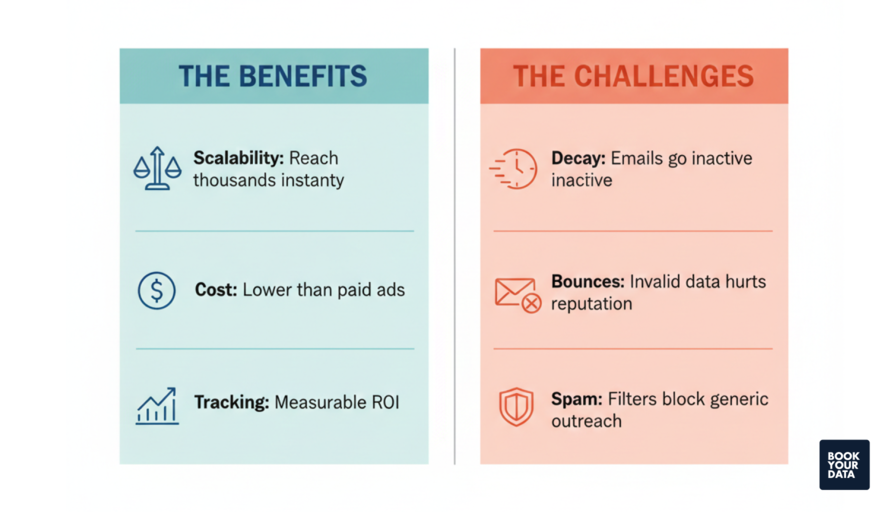
The benefits of email lead generation are to capture high-quality leads at scale, increase brand awareness and audience interest, track and measure campaign performance, and reduce marketing costs.
The benefits of email lead generation are outlined below.
- Capture high-quality leads at scale: Email lead generation reaches people who have already expressed interest (opted in), so you start with a list of prospects who are more likely to convert rather than a random audience.
- Increase brand awareness and audience interest: Regular emails help keep your business visible to potential customers and maintain their interest in your products or services.
- Track and measure campaign performance: Email tools allow you to monitor how recipients respond to your emails, such as opens, clicks, and actions, to understand results clearly.
- Reduce marketing costs: Email lead generation is less expensive compared to many traditional marketing methods and allows you to reach many leads without high advertising or distribution costs.
What are the challenges of email lead generation?
The challenges of email lead generation are low conversion rates, high bounce rates, dealing with spam, and a lack of clear and measurable goals.
The challenges of email lead generation are listed below.
- Low conversion rates: Many recipients read or open the emails but do not take the intended action, mostly because the content does not engage or clearly guide them.
- High bounce rates: Emails sent to invalid or outdated addresses return as undeliverable, which reduces the number of people you actually reach and affects the credibility of future campaigns.
- Dealing with spam: Some emails land in spam folders or sometimes are not delivered because of spam filters, poor sender reputation, or wrong technical setup. These spam issues also impact the effectiveness of the whole campaign.
- Lack of clear and measurable goals: Sometimes marketers focus only on basic metrics, like emails sent or opened, without defining success clearly. It is difficult to measure if the campaign is effective without knowing what counts as a qualified lead or actual conversion.
Comparison of the benefits and challenges of email lead generation
What are the best practices of email lead generation?
The best practices of email lead generation include reaching the right audience, providing useful and relevant incentives, using reliable email capture tools, following up promptly, personalizing your emails, and complying with privacy and data protection laws.
Reach the right audience
Reaching the right audience means using explicit opt‑in methods so only people who want your content subscribe. Targeting the right audience improves not only your signup numbers but also the quality of leads. Avoid purchasing or renting email lists, which mostly include outdated contacts, because they affect deliverability and violate anti-spam regulations.
Provide useful and relevant incentives
Providing useful and relevant incentives is the process of offering something useful in exchange for their email, such as a free guide, a helpful resource, a newsletter, or a tool, so subscribers feel there is real value in signing up.
Use reliable email capture tools
Using reliable email capture tools means utilizing opt-in or double opt-in forms to collect or verify consent and making sure the subscription is authentic and compliant with privacy standards.
Follow up promptly
Prompt follow-up builds relations and prevents lost engagement once a visitor signs up. Send a welcome email or confirmation email right away, ideally within minutes, which helps confirm their subscription and reminds them of the value they signed up for. Remove invalid or inactive addresses, handle unsubscribe requests quickly, and keep your mailing list updated to confirm deliverability.
Personalize your emails
Personalized messages feel more relevant and show that you understand your audience, which improves open rates, click-throughs, and conversions. Customizing subject lines, content, and even sending times based on data helps build stronger relationships than one-size-fits-all emails.
Comply with privacy and data protection laws
Collect only necessary data that complies with laws and regulations, like GDPR (General Data Protection Regulation) or other regional privacy laws. These laws mandate that you get clear, explicit consent (opt-in), be transparent about data usage, and provide a clear unsubscribe option.
How to measure the success of email lead generation?
To measure the success of email lead generation, consider delivery rate, open rate, CTR (Click-Through Rate), CTOR (Click-to-Open Rate), conversion rate, and bounce rate.
Delivery rate determines the percentage of emails that actually reach recipients’ inboxes compared to the total sent. A high delivery rate shows that your list is accurate and your sending practices are effective.
Open rate measures the percentage of recipients who open your delivered emails. This rate shows how effectively your subject lines and sender identity attract attention.
CTR (Click-Through Rate) evaluates the percentage of delivered emails that result in at least one click on a CTA, link, or button. This CTR rate measures the relevancy and engagement of your email content.
CTOR (Click-to-Open Rate) measures the number of people who clicked on a link and the responsiveness rate among those who opened the email. This CTOR rate helps show if your email content matches what your subject line suggests.
Conversion rate determines the percentage of recipients or of delivered emails who complete the intended action, such as signing up, downloading, or purchasing. This metric shows the number of leads that actually convert.
Bounce rate or failed delivery rate measures how many emails did not reach recipients due to hard or soft bounces. A high bounce rate shows problems with your email list or sending process.
What are the best tools for generating high-quality email leads?
The best tools for generating high-quality email leads include BookYourData, HubSpot, Cognism, and Kaspr.
BookYourData is a B2B lead generation platform that provides access to over 100 million verified business contacts across multiple industries. Users filter leads by industry, job title, company size, and location to build highly targeted email lists. It helps improve outreach success and reduces wasted effort on outdated or incorrect contacts, with an average data accuracy rate of 97%.
HubSpot is a comprehensive marketing, sales, and CRM platform that includes email marketing and lead generation features. HubSpot allows you to create signup forms, manage contact lists, automate email campaigns, track engagement, and score leads, which help businesses generate and nurture high-quality email leads.
Cognism is a B2B sales platform that provides a global database of business contacts and companies. Cognism offers tools for prospecting, compliance-checked email campaigns, and enriched data to help sales and marketing teams find and reach relevant leads effectively.
Kaspr is a lead generation tool focused on finding contact details, especially emails and phone numbers, for LinkedIn profiles. It helps users quickly build lists of prospects from LinkedIn and other sources for outreach purposes.
How do I get an email address for lead generation?
You can get email addresses for lead generation by using opt-in forms, gated content, lead magnets, and newsletter subscriptions to capture interested users. B2B tools like BookYourData provide verified email lists.
How often should I follow up on my emails?
You should follow up on emails promptly and consistently. Wait 2 to 3 days after sending your first email before following up, but adjust the timing based on the email’s purpose, the recipient’s behavior, and other relevant factors.
Is it legal to buy email lists?
Buying email lists is legal in some regions, but is mostly avoided because it violates anti-spam laws like CAN-SPAM (US) or GDPR (EU). Purchased lists usually include unverified contacts, increasing spam complaints and affecting deliverability. Building your own opt-in email list ensures compliance and higher engagement.
How to generate email marketing leads?
To generate email marketing leads, you can generate email marketing leads by creating valuable content such as ebooks, guides, or discounts that increase sign-ups. Use opt-in forms, landing pages, and lead magnets to capture emails. Promote through social media, blogs, and paid ads, and use B2B tools like BookYourData for verified business contacts.
How much does an email lead cost?
An email lead costs differ depending on factors such as industry, lead quality, sourcing method, and channel. The cost per lead across industries is approximately $198.44, but email-specific lead costs range from $40 to $250 per lead, which depends on targeting and quality.
How can I re‑engage inactive email leads?
You can re-engage inactive email leads by segmenting your list, then sending a friendly, personalized email with a special offer or incentive to inactive leads. Follow up with a stronger incentive or exclusive content if they still do not respond. Finally, monitor results, like opens, clicks, or unsubscribes, and clean out leads who remain unresponsive after a defined re-engagement campaign.
How can B2B email list providers help generate high-quality email leads?
B2B email list providers can help generate high-quality email leads by delivering accurate, up-to-date contact info and filtering prospects by industry, company size, or job title, so you reach decision-makers. B2B email list providers save time and cost by replacing manual prospecting and allowing quick access to a large number of relevant contacts for scalable outreach.
What are the best email finder tools to generate high-quality email leads?
The best email finder tools to generate high-quality email leads are BookYourData, UpLead, Apollo.io, and Lusha. Some other best email finder tools include Snov.io, RocketReach, and Hunter.io.
How can effective lead sourcing improve email lead quality?
Effective lead sourcing can improve email lead quality by focusing on prospects who match your ideal customer profile (industry, company size, role) and show buying intent, not random contacts. These lead sourcing tips make sure that your outreach reaches decision-makers who are more likely to convert, reducing sales cycles and increasing ROI.
How to build a high-quality email list?
To build a high-quality email list, prioritize opt-in and value, and offer useful lead magnets, such as guides, webinars, or checklists, in exchange for signups. Creating email lists includes placing simple, visible signup forms on high-traffic pages and on social media, using a double-opt-in confirmation, segmenting your list, and sending targeted content.
[CTA1]

.png)