What are Verified Leads: The Complete Guide to Finding and Converting High-Quality Prospects in 2026
Verified leads are prospects whose contact information has been authenticated and confirmed as accurate through verification systems. Bad data costs businesses an average of $12.9 million annually, as mentioned in Gartner’s study “Data Quality: Best Practices for Accurate Insights.” And B2B email databases decay by at least 22.5% annually, according to HubSpot’s “Database Decay Simulation.” This decay rate makes verification critical for sales teams that want genuine connections with potential buyers.
This guide covers what verified leads are, how to get them, verification methods, tools, and best practices for maintaining accurate contact databases. It is important to understand the importance of verified leads, as it prevents sales representatives from wasting their time pursuing bad leads. Verified leads play a major role in helping teams focus on real opportunities.
What are verified leads?

Verified leads are prospects whose contact information has been scored and authenticated through verification systems. These leads have passed tests confirming that their email addresses, phone numbers, and other details are genuine and accessible.
Verification filters out fake leads, temporary addresses, bogus phone numbers, and spambots. Sales teams can focus on contacting real users and be sure there will be a genuine prospect at the other end. Lead verification also saves money by making sure salespeople do not waste time with invalid leads.
The 1-10-100 rule, developed by George Labovitz and Yu Sang Chang in 1992, illustrates the cost of bad data. It costs $1 to prevent a data error at capture. It costs $10 to correct an error after entry, and it costs $100 if the error leads to failure in outreach or campaigns.
Why are verified leads important?
Verified leads are important because they directly impact efficiency, conversion rates, and ROI, and high-quality leads convert significantly better than general leads. Organizations using data-driven marketing strategies see an average 15% increase in ROI, according to “Data-Driven Strategies for Enhanced ROI” by The Logit Group. Personalized campaigns relying on accurate data deliver higher conversion rates than generic campaigns.
U.S. businesses lose approximately $3.1 trillion each year due to poor data quality, according to IBM research, where companies lose 12% to 25% of their revenue due to inaccurate data, as per industry analysis by Thomas Redman. Clean data drives 20% better campaign response rates and 15% higher close rates within six months of implementation, according to the article titled “Data Decay Rate Statistics” by Landbase.
What are the types of verified leads?
The types of verified leads include B2B leads, real estate leads, travel leads, franchise leads, mortgage leads, and auto leads. Verified leads can also be categorized as inbound (actively seeking information) or outbound (generated through proactive outreach). Understanding these types helps businesses target efforts more effectively.
Verified B2B leads
Verified B2B leads are business-to-business leads that have passed email verification, which confirms they are real business contacts. These leads guarantee B2B marketing campaigns reach professionals with purchasing authority and target decision-makers like C-suite executives, VPs, directors, and managers to increase conversion potential.
The B2B leads platform allows sales teams to filter by job title, industry, company size, and technology usage to build targeted prospect lists.
Verified real estate leads
Verified real estate leads are approved buyers, sellers, and investors looking for properties on the market, which are essential for real estate agents and brokers in the real estate sector. Real estate leads have large purchasing power for one-time purchases, and a few accurate leads result in a reasonable profit. Verification of real estate leads makes sure agents deal only with serious property buyers rather than casual browsers.
Verified mortgage leads
Verified mortgage leads are users potentially interested in getting large loans using property as leverage. These leads are among the most expensive lead types due to high transaction values. Verified mortgage leads help professionals target creditworthy borrowers to increase loan approval rates.
Verified franchise leads
Verified franchise leads are individuals or companies interested in owning and operating a franchise. These leads have greater purchasing power and spend a longer time researching before committing. Verification maintains communication with potential franchisees who meet financial and operational requirements.
Verified auto leads
Verified auto leads are prospects in the market searching for vehicles and spending time comparing prices and educating themselves before purchasing. These leads are very important for car traders, dealerships, and car sellers. Verification confirms sales teams target genuine vehicle buyers who are ready to make purchasing decisions.
Verified travel leads
Verified travel leads are users who are looking for transportation and accommodations for their upcoming journeys. These leads are less likely to become long-term customers, as they typically look for the best deals from multiple sources in short time frames and require quick follow-up. Verification is important so agencies and travel service providers can target potential customers and minimize cases of targeted marketing to the wrong leads.
Inbound and Outbound verified leads
Inbound verified leads come from individuals who are actively searching for information or services. They show interest through website visits, form submissions, content downloads, and social media interactions.
Outbound verified leads generate through proactive outreach efforts like cold calling, email campaigns, and targeted lists based on demographics or industry.
Both types have unique advantages that can be combined for maximum reach. Inbound leads demonstrate interest, while outbound requires personalized communications to engage prospects.
Comparison of types of verified leads
The table below gives a comparison of different types of verified leads.
What are the techniques for lead verification?
Lead verification techniques filter potential customers through specific criteria to remove invalid contacts. The seven main techniques for lead verification are listed below.
- Use real-time email verification APIs: These APIs validate email addresses instantly as users enter them into web forms. Validation occurs within seconds, which provides immediate feedback.
- Partner with verified lead providers: B2B data platforms maintain databases of business leads. They use automated checks and validation processes to ensure data accuracy.
- Implement double opt-in confirmation: This process requires leads to confirm their email address by clicking a verification link when they try to access any source the business provides. It confirms genuine interest and provides documented proof of consent.
- Conduct quarterly database audits: CRM data can decay by over 30% annually, and email databases also decay by at least 22.5%. Regular audits identify and remove outdated, duplicate, or incorrect information.
- Utilize intent data to identify high-quality prospects: Intent data tracks digital behaviors that indicate buying interest. Some platforms, like Bombora and 6sense, use data sources to detect buying signals.
- Use OTP (One-Time Password) verification: OTP methods are used when a user registers with personal information in sign-up forms or applications. OTP sends a unique, time-sensitive code to phone numbers, which the users must enter to prove ownership and active possession.
- Integrate verification tools directly with your CRM: CRM integration makes sure contact details are continuously checked and updated in real time without manual intervention, which saves time and labor.
What is the lead verification process?
The lead verification process confirms the accuracy and authenticity of a lead's contact information. It checks if details like email addresses, phone numbers, and physical addresses are valid and belong to a real person.
Lead validation goes to assess if a lead is a good fit for your business beyond accuracy. It checks the lead's attributes against your ICP (Ideal Customer Profile), evaluating factors like company size, industry, budget range, and decision-making authority.
Lead qualification determines a lead's sales-readiness and potential to become a customer. Sales teams often use the BANT framework (Budget, Authority, Need, Timeline), and a lead is often considered qualified if they meet at least 3 of the 4 BANT criteria.
These three processes work together in the sales funnel. Verification confirms data accuracy, validation confirms fit, while qualification confirms readiness to buy.
What is the email verification process?
Email verification is a multi-step method to determine if an email address is valid without actually sending an email. The process includes three main stages.
- Step 1 - Syntax check: This check validates email format against RFC (Request for Comments) standards. It looks for missing @ symbols, illegal characters, and valid top-level domains.
- Step 2 - Domain/MX record check: This step queries DNS (Domain Name System) to verify the domain exists and has MX (Mail Exchange) records configured to receive email. If no MX records exist, the domain cannot receive email.
- Step 3 - SMTP handshake (Mailbox ping): The verification tool connects to the mail server and initiates an SMTP (Simple Mail Transfer Protocol) conversation using HELO/EHLO, MAIL FROM, and RCPT TO commands, and the server's response determines validity. This process also identifies disposable emails, spam traps, and blacklisted domains.
What is the phone verification process?
Phone number verification is a multi-step technical process with four stages.
- Step 1 - Syntax check: This confirms the number is in valid format with correct number of digits and country code.
- Step 2 - Database lookup: HLR (Home Location Register) lookup queries the mobile carrier's live database. It checks if the number is active, disconnected, or temporarily unreachable.
- Step 3 - Line type identification: This step distinguishes between mobile, landline, and VoIP numbers. This is critical since landlines cannot receive SMS.
- Step 4 - Real-time check: OTP verification sends a unique time-sensitive code that the user must enter to prove ownership. OTP confirms active possession but is not scalable for cleaning large lists.
What is the address verification process?
Address verification guarantees the accuracy of physical addresses for offline marketing efforts. The process includes three steps.
- Step 1 - Standardization: This step formats the address for consistency with postal services.
- Step 2 - Cross-referencing: Cross-referencing checks the address against postal databases to confirm its legitimacy.
- Step 3 - Geocoding: This converts the address into geographical coordinates to validate its existence. Address verification is crucial for direct mail campaigns and ensuring the target audience is reachable.
What are the benefits of verified leads?
The benefits of verified leads include enhanced data accuracy, increased conversion rates, optimized resource allocation, maintained compliance, reduced time and costs, improved customer experience, and strengthened sender reputation. Verified leads transform sales strategy by ensuring teams focus on genuine opportunities.
- Enhanced data accuracy: Verification confirms contact details are correct and up-to-date, which reduces wasted efforts and resources on invalid contacts andimproves data accuracy.
- Increased conversion rates: High-quality leads convert significantly better, as companies with strong lead nurturing generate 50% more sales-ready leads at 33% lower cost, according to Forrester Research and HubSpot.
- Optimized resource allocation: Sales teams focus on leads with authentic interests rather than chasing invalid contacts. This reduces costs associated with marketing to unqualified leads.
- Maintained compliance: Verified leads help stay compliant with regulations such as GDPR and CAN-SPAM, which minimizes the risk of legal issues.
- Reduced time and costs: Sales reps stop wasting their time on bad data and focus on accurate leads to nurture and pass through the sales funnel. Clean data drives faster sales cycles and better ROI.
- Improved customer experience: Accurate data allows personalized outreach, and personalized campaigns deliver higher engagement rates.
- Strengthened sender reputation: Low bounce rates and fewer spam complaints protect email deliverability, while poor data leads to blacklisting by email service providers.
What are the best lead verification tools for 2026?
Lead verification tools help sales and marketing teams verify contact data before launching outreach campaigns by providing real-time email validation, phone verification, and data enrichment capabilities. These platforms reduce bounce rates, protect sender reputation, and increase campaign ROI by confirming messages reach valid recipients.
Different tools specialize in different aspects of lead verification. Some focus on email verification as their core function, while others offer full B2B lead generation with verification built in. The right choice depends on your team's specific needs, budget, and outreach volume.
The best lead verification tools of 2026 are given below.
- ZoomInfo: ZoomInfo is an enterprise-grade sales intelligence platform combining B2B contact data with intent signals, conversation intelligence, and automation tools. The platform offers 260M+ professional profiles with verified emails and phone numbers. Enterprise sales teams use ZoomInfo for full-funnel go-to-market execution.
- BookYourData: BookYourData is a B2B lead generation platform that offers 500M+ verified business profiles across 200+ countries. The platform provides real-time email verification with a 97% accuracy guarantee and pay-as-you-go pricing. Sales teams use BookYourData to build targeted prospect lists with verified emails, direct dials, and company data.
- ZeroBounce: ZeroBounce is an email verification and deliverability platform that validates email addresses through multi-step verification. The tool detects spam traps, abuse emails, and catch-all domains and offers additional deliverability tools such as blacklist monitoring and email warmup. Marketing teams use ZeroBounce to maintain clean email lists and protect sender reputation.
- Hunter.io: Hunter.io is an email finder and verification tool that helps sales professionals locate and validate professional email addresses. The platform searches by domain or individual name and includes a Chrome extension for LinkedIn prospecting. Hunter.io also offers cold email campaign features with AI-powered writing assistance.
- NeverBounce: NeverBounce is a bulk email verification service that processes large email lists through a proprietary 20+ step verification process. The platform checks each email up to 75 times from global locations using MX, DNS, and SMTP verification. NeverBounce integrates with major CRM and marketing platforms via Zapier.
- Lusha: Lusha is a B2B contact data platform with a Chrome extension that reveals contact information while browsing LinkedIn. This lead verification tool provides direct phone numbers, verified emails, and company data for 300M+ business profiles. Sales development reps use Lusha for quick prospecting without leaving their browser.
- Saleshandy: Saleshandy is an AI-assisted cold email platform that combines lead finding with email verification and outreach automation. The platform offers unlimited email account connections, sender rotation, and email warmup. Sales teams use Saleshandy to run personalized cold email campaigns at scale with built-in deliverability protection.
- UpLead: UpLead is a B2B prospecting platform providing access to 108M+ verified contacts with real-time email verification. The tool offers 50+ search filters, technographic data, and buyer intent signals. Small to mid-sized sales teams use UpLead as a cost-effective alternative to enterprise data providers.
- MillionVerifier: MillionVerifier is a bulk email verification service that offers low-cost list cleaning with syntax checking, domain verification, and SMTP validation. The platform includes EverClean, an automated solution that continuously monitors and cleans email lists. Budget-conscious marketers use MillionVerifier for affordable email hygiene at scale.

Comparison table of the best lead verification tools for 2026
What are the best practices for maintaining a verified lead database?
The best practices for maintaining a verified lead database include establishing data governance policy, standardizing data entry and formats, conducting regular data audits, using automated cleaning tools, removing unengaged leads, and integrating verification with CRM. These practices help to make sure verified leads remain accurate and valuable, which maintains a high-quality lead database.
The best practices for maintaining a verified lead database are below.
- Establish data governance policy: Create a formal framework of rules, roles, and processes for managing data assets. Define who can access and modify data, and create accountability for accurate data.
- Standardize data entry and formats: Create consistent formats for phone numbers, addresses, job titles, and company names. This prevents duplicates and makes data easier to search.
- Conduct regular data audits: Schedule quarterly audits since CRM data can decay by over 30% annually. Use automated tools to flag potential issues and prioritize manual review of high-value accounts.
- Use automated cleaning tools: Automated tools flag potential issues automatically and help identify duplicates, outdated information, and formatting inconsistencies.
- Remove unengaged leads: Regularly eliminate leads who have not interacted within 6-12 months, as unengaged leads harm sender reputation over time.
- Integrate verification with CRM: Make sure contact details are continuously checked and updated in real time. CRM integration eliminates manual verification steps.
What mistakes should you avoid when verifying leads?
Businesses should avoid the following mistakes when verifying leads.
- Verifying only at the point of capture without ongoing database maintenance. Data decays 2.1% per month, according to HubSpot research, so continuous verification is required.
- Relying solely on syntax checks without deeper mailbox verification, because syntax checks catch formatting errors but miss invalid mailboxes.
- Ignoring phone number line type (landlines vs mobiles for SMS campaigns), as landlines cannot receive SMS messages.
- Not removing unengaged leads that harm sender reputation over time, because high bounce rates lead to email blacklisting.
- Using free verification tools without accuracy guarantees for business-critical campaigns, where free tools often lack the depth of paid verification services.
- Failing to integrate verification into CRM workflows for real-time updates. Manual processes create delays and errors.
Avoiding these mistakes helps maximize ROI from lead verification efforts.
How can verified leads transform business sales strategy?
Verified leads can transform business sales strategy and have a direct impact on business growth. They eliminate wasted time on invalid contacts and increase conversion rates by focusing sales efforts on genuine prospects. They also protect sender reputation and email deliverability.
Organizations addressing data decay through continuous enrichment and validation report 15% improvement in close rates within six months, according to the article titled “Data Decay Rate Statistics” by Landbase. Clean data allows more effective targeting, better qualification, and improved sales productivity.
What is the future of lead verification?
The future of lead verification includes AI-powered predictive lead scoring, automated qualification through chatbots, real-time data enrichment, and behavioral analysis with intent signals. AI lead generation uses machine learning models to analyze historical and real-time data, where these models identify patterns that correlate with conversion and assign dynamic scores predicting purchase likelihood. These signals provide insight into prospect readiness and help sales teams focus on potential clients who have shown real interest.
How do verification tools verify leads?
Verification tools verify leads through automated checks, which include syntax validation, domain verification, SMTP handshakes, and database lookups. They use APIs to perform real-time validation in milliseconds. Advanced tools also check for disposable emails, spam traps, and blacklisted domains.
Can I get verified email lists?
Yes, you can get verified email lists from B2B data providers. These providers maintain databases of pre-verified contacts. They validate email addresses in real time before download.
Can lead verification help reduce spam?
Yes, lead verification helps reduce spam by ensuring emails reach valid recipients. It identifies and removes spam traps, temporary email addresses, and invalid contacts. This protects sender reputation and improves email deliverability rates.
How much does lead verification help for lead generation?
Lead verification helps for lead generation and improves outcomes. Companies implementing marketing automation with verified data see a 451% boost in qualified leads, according to Revenue Ops LLC. Organizations report 15% improvement in close rates within six months of implementing data quality practices, and clean data drives 20% better campaign response rates, as per Landbase’s “Data Decay Rate Statistics.”
How to do effective lead generation for small businesses?
To do effective lead generation for small businesses, use pay-as-you-go data providers to control costs. Implement real-time verification on lead capture forms. Focus on quality over quantity by targeting specific industries and job titles. Use referral programs since referral marketing generates conversion rates 3-5x higher than other channels.
How often should lead verification be updated?
Lead verification should be updated continuously through CRM integration for real-time validation. At minimum, conduct quarterly database audits, as B2B data decays at 2.1% per month, meaning 22.5% becomes outdated annually, according to HubSpot study.
What is the difference between real-time and bulk verification?
Real-time verification validates individual contacts instantly as they are entered, typically within 100-500 milliseconds. Bulk verification processes large lists of contacts at once for cleaning existing databases. Real-time verification prevents bad data entry, while bulk verification cleans historical data.
How can I generate leads quickly?
To generate leads quickly, use verified lead providers for instant access to pre-validated contacts. Lead generation techniques include building targeted lists using filters for job title, industry, location, and company size, implementing real-time verification APIs on forms to capture leads immediately, and using intent data to identify prospects actively researching solutions.
How much does lead verification cost?
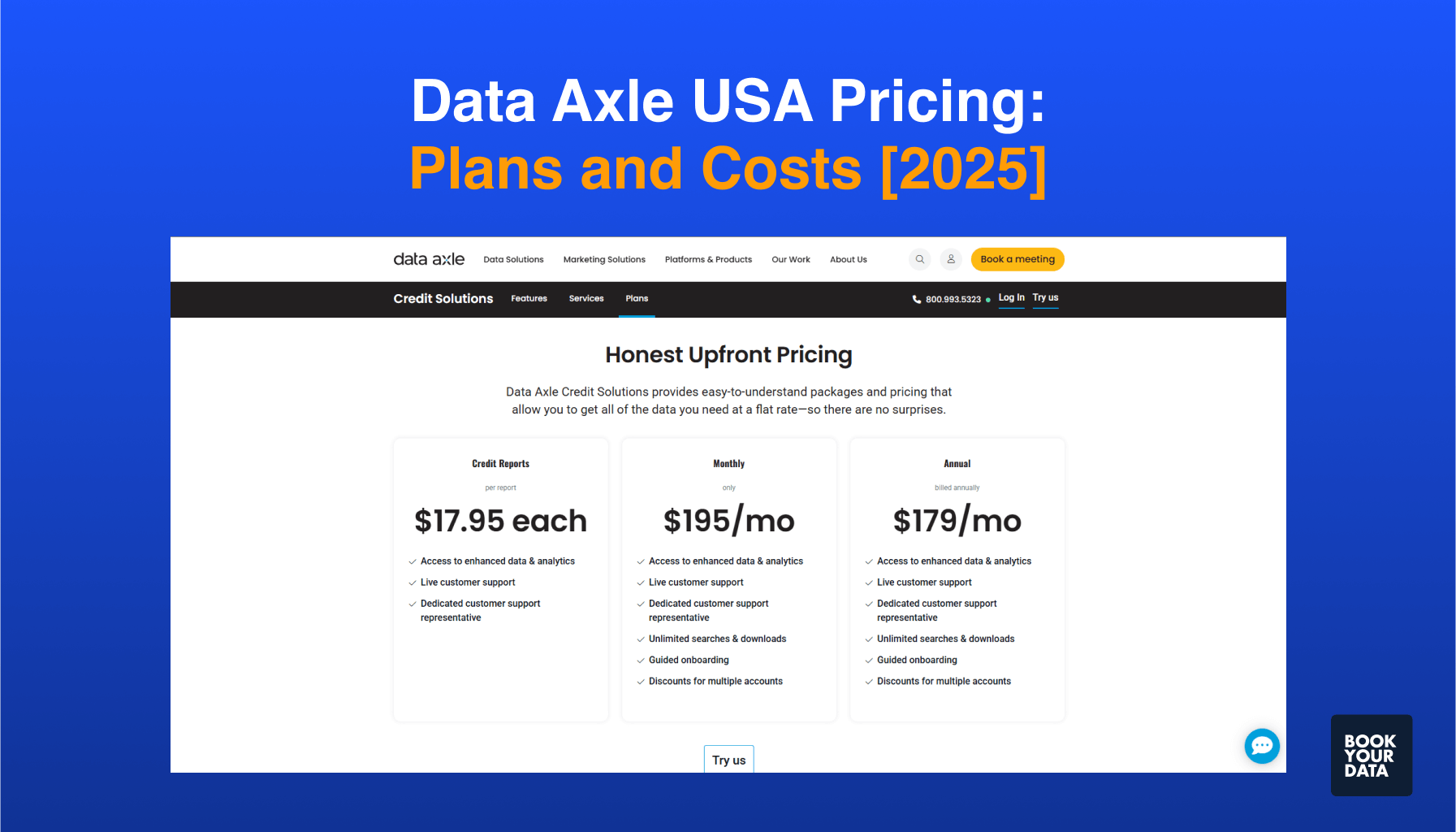
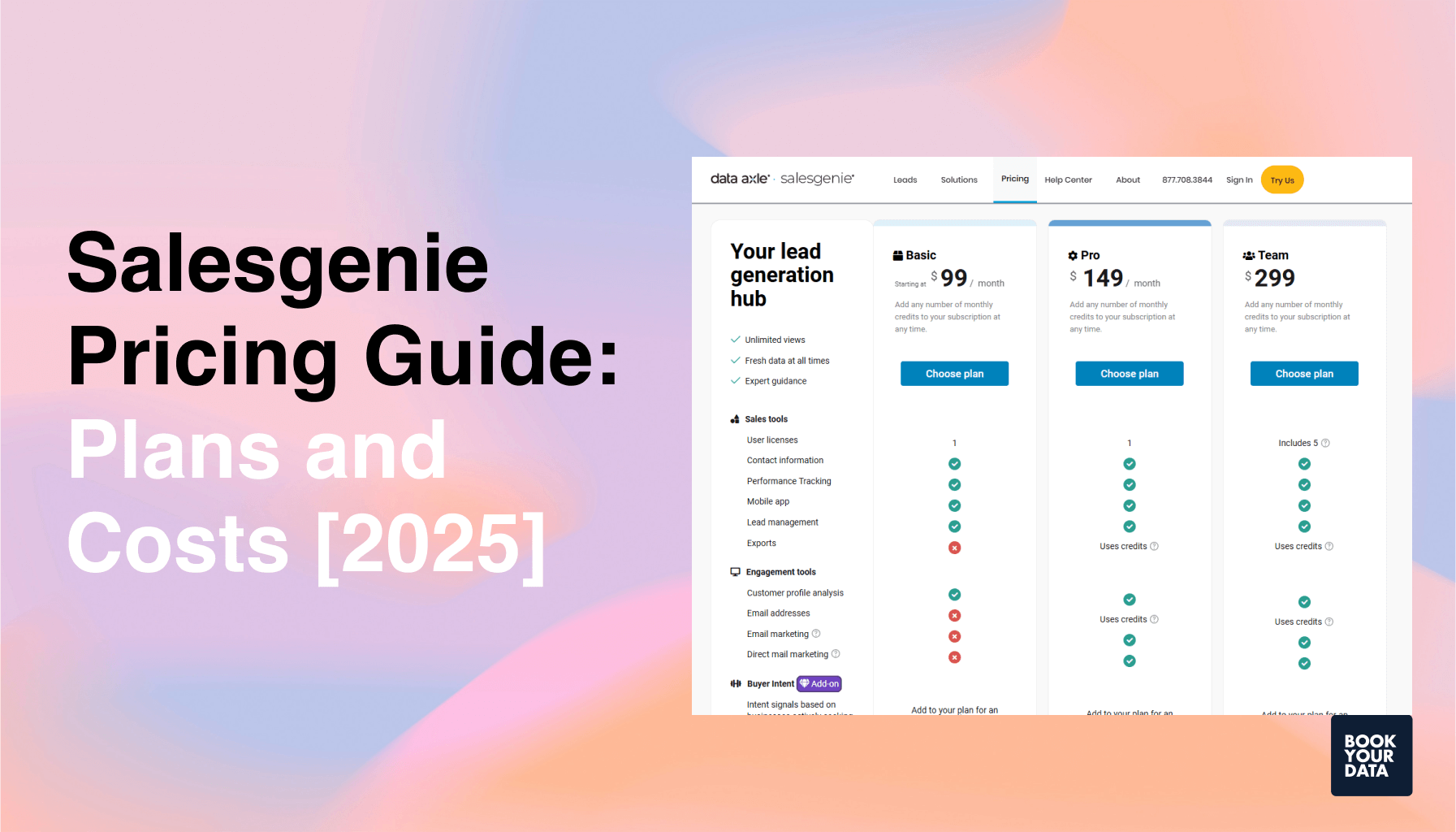
Lead verification costs vary by provider and volume. Enterprise platforms like ZoomInfo cost $15,000+ annually. The 1-10-100 rule shows that prevention costs $1, correction costs $10, and failure costs $100 per contact. BookYourData offers pay-as-you-go pricing starting at $99 for 250 credits, and the higher volume discounts reach up to $0.010 per contact, with no subscription required. Email verification tools like ZeroBounce start from $18/month.
What accuracy rate should you expect from verified leads?
Accuracy rates for verified leads range from 90% to 97% depending on the provider. BookYourData offers a 97% accuracy guarantee with bounce-back refunds. Industry average accuracy is around 50-60% for unverified data, so always choose providers that offer accuracy guarantees for business-critical campaigns.
Are verified leads GDPR and CCPA compliant?
Yes, verified leads from reputable providers are GDPR and CCPA compliant when sourced and used correctly. Compliance requires that contacts have provided accurate information and consented to communications. Double opt-in verification provides documented proof of consent. Always verify provider compliance certifications before purchasing lead lists.
Verified leads eliminate wasted time and resources spent chasing invalid contacts. They increase conversion rates, protect sender reputation, and drive better ROI.
[CTA1]

.png)