Top 16 6Sense Competitors and Alternatives for B2B Intent Data [2026]
6sense is an ABM (Account-Based Marketing) platform that uses AI and predictive analytics to identify buyer intent signals. This ABM platform tracks anonymous website visitors, captures purchasing behavior, and scores accounts based on conversion possibility. Sales and marketing teams use 6sense to prioritize high-value prospects and run targeted campaigns.
6sense requires annual contracts with implementation fees, credit-based pricing, and add-on costs for intent data that increase the overall expenses. Many users report data accuracy and lead quality issues after the initial months, so they look for competitors or 6sense alternatives.
| 6Sense Alternative | Data Type | Data Accuracy | Data Coverage (Region Focused) | Pricing Starts at | G2 Rating |
|---|---|---|---|---|---|
| BookYourData | B2B contact, email, phone, firmographic | 97% | Global (200+ Countries) | $99 for 250 credits | 4.9 |
| ZoomInfo | Company profiles, contacts, intent | 75% - 95% | North America | $14,995 per year | 4.5 |
| UpLead | B2B contact, email, technographic | 95% | Global, 160M+ contacts | $99 per month | 4.7 |
| Cognism | B2B contact, phone-verified mobile | 85% | EMEA, NAM, APAC | $15,000 access fee | 4.5 |
| Apollo.io | B2B contact, email sequence | 91% | Global (US mainly) | $49 per month if billed annually | 4.7 |
| Seamless.AI | B2B contact, real-time AI | 90% | North America (mainly) | $99 per month | 4.4 |
| Clay | Data enrichment, 150+ sources | — | Global | $134 per month for yearly billing | 4.8 |
| RocketReach | B2B contact, email, phone | 85%-98% | Global | $27 per month if billed annually | 4.4 |
| Clearbit | Data enrichment, firmographic | 85%-94% | Global (US mainly) | $45/month | 4.4 |
| Lead411 | B2B emails and contacts | 96% | North America | $49 per month | 4.5 |
| DemandScience | ABM, account ID, advertising | — | North America | Custom pricing | 4.4 |
| Lusha | B2B contact and company intel | 95% | Global (EU Strong) | $29.90 per month | 4.3 |
| Demandbase | ABM, intent, account intelligence | 92% | North America (mainly) | Starting from at least $24,000/year + other charges for services | 4.4 |
| D&B Hoovers | Company and contact data | 90% (Company) | Global | $49 per month | 4.1 |
| HubSpot Marketing Hub | CRM, marketing automation | — | Global | $9 per month | 4.5 |
| Dealfront | B2B contact, web visitor ID | 85%-90% | Europe (DACH, Nordic) | $99 per month | 4.5 |
What are the best 6sense competitors and alternatives?

The best 6sense competitors and alternatives include Demandbase, ZoomInfo, Bookyourdata, UpLead, Cognism, Apollo.io, Seamless.AI, Clay, RocketReach, Clearbit, Lead411, DemandScience, Lusha, D&B Hoovers, HubSpot Marketing Hub, and Dealfront.
The best 6sense competitors and alternatives are listed below.
- Demandbase: Demandbase is a B2B ABM (Account‑Based Marketing) and revenue‑marketing platform that unifies intent data, sales intelligence, and advertising into one AI‑powered GTM solution.
- ZoomInfo: ZoomInfo is a B2B go-to-market intelligence platform providing detailed, real‑time company and contact data for sales, marketing, and recruiting teams.
- BookYourData: BookYourData is a B2B sales intelligence platform offering real‑time, verified company and contact data with 97% accuracy and a pay‑as‑you‑go model.
- UpLead: UpLead is a B2B sales intelligence platform that provides real‑time verified emails, mobile numbers, and intent data for over 160 million contacts.
- Cognism: Cognism is a global B2B sales intelligence platform that provides GDPR‑compliant contact and company data, intent signals, and verified phone numbers to help revenue teams prospect more effectively.
- Apollo.io: Apollo.io is an AI‑powered B2B sales platform combining a database of 210M+ verified contacts, engagement automation, intent signals, and CRM enrichment.
- Seamless.AI: Seamless.AI is an AI‑powered B2B sales intelligence and data enrichment platform that provides real‑time access to verified emails, phone numbers, and company data to support smarter prospecting and pipeline building.
- Clay: Clay is an AI‑powered GTM (Go‑to‑Market) platform that enriches data by combining 130+ sources, automates workflows, and allows research and outreach in a spreadsheet-style interface.
- RocketReach: RocketReach is a B2B contact‑discovery platform that provides access to verified emails, direct dials, and social profiles for over 700 million professionals.
- Clearbit: Clearbit is a B2B data enrichment and intelligence platform that improves company and contact records with 100+ attributes from more than 250 public and private sources.
- Lead411: Lead411 is a B2B lead‑generation and sales intelligence platform offering real‑time, triple‑verified contact data, growth‑intent insights, and smooth CRM integrations.
- DemandScience (Terminus): A unified B2B revenue‑marketing and ABM (Account-Based Marketing) platform combining account intelligence, intent data, and omnichannel activation.
- Lusha: Lusha is a B2B sales‑intelligence platform that provides accurate, verified business contact information (emails, phone numbers, LinkedIn) and integrates with CRMs.
- D&B Hoovers: D&B Hoovers is a B2B sales‑intelligence platform powered by Dun & Bradstreet. It offers real‑time business data, deep account research, and prospecting insights.
- HubSpot Marketing Hub: HubSpot Marketing Hub is a comprehensive marketing software that helps with lead generation, email automation, content management, and campaign reporting within HubSpot’s unified CRM platform.
- Dealfront: Dealfront is a European GTM (Go‑to‑Market) platform offering GDPR‑compliant B2B data, intent signals, and web visitor tracking.This table provides a comparison of leading B2B sales intelligence and marketing platforms. It compares their data types, accuracy, regional coverage, pricing, and G2 ratings.
Demandbase
Best for
Enterprise sales and marketing organizations using account-based marketing need a large AI-curated contact database with firmographics, technographics, intent data, and account intelligence.
About
Demandbase is an ABM (Account-Based Marketing) and GTM (Go-to-Market) platform that combines account intelligence, advertising, sales insights, and data management into a single solution. This platform uses AI to identify high-value accounts, track buyer intent signals, and personalize engagement across the entire customer experience.
Features
- AI-powered identification and scoring of high-value target accounts.
- Customizable pipeline tracking from prospect to customer renewal.
- Real-time alerts and engagement tracking for sales teams.
- Purpose-built DSP (Demand-Side Platform) for account-based advertising.
Pros
- Unified platform combines ABM, advertising, and sales intelligence in one place.
- Strong Salesforce integration enables account data sync and workflow automation.
- Predictive models generate results in under 24 hours.
- Responsive customer support with dedicated success managers.
Cons
- A complex setup requires a dedicated operations team for full implementation.
- Steep learning curve for non-power users due to complex features.
- CPM rates for display advertising are higher than the industry average.
- IP-based identification accuracy drops when visitors use VPNs.
Reviews
| What users like | What users dislike |
|---|---|
| Demandbase unifies ABM, intent data, and sales intelligence, providing shared account visibility, real-time insights, and smooth integrations to improve targeted, strategic engagement. — Sadhwi P. | Inaccurate revenue and employee data in Demandbase One leads to unreliable ABM criteria and causes wrong account entry or missed targets. — Chase H. |
| Demandbase allows targeted messaging with a user-friendly platform that simplifies campaign creation and supports delivering a strong audience experience. — Michel M. | Duplicate profiles, outdated contact details, and limited verification checks reduce data accuracy and make the platform's contact list unreliable. — Savitha Y. |
Pricing
Demandbase offers customized pricing plans to its users. It has three plans: the Essentials plan starting at $3,995/month, Growth starting at $7,995, and the Enterprise plan, which is a custom plan.
Demandbase vs 6sense
| Demandbase | 6sense |
|---|---|
| Scalable for businesses of different sizes needing flexible ABM, advertising, and sales features. | Best for revenue teams needing deep predictive insights and multi-channel sales-marketing orchestration. |
| Customized packages based on features and user count, adjusted for scaling teams. | Credit-based pricing, costly for larger teams. |
| Strong analytics on account-based efforts and pipeline impact. | Advanced reporting to improve go-to-market and pipeline health. |
What I liked about Demandbase?
Demandbase offers advanced account-based marketing tools with precise targeting, company insights, and intent data. Its real-time engagement tracking, personalized campaigns, and analytics dashboards helps teams identify high-value accounts, optimize outreach, and simplify marketing strategies without manual data collection.
BookYourData
Best for
SMBs, agencies, and small teams need affordable, pay‑as‑you‑go B2B contact data with real‑time email verification and granular filters, which include job title, company size, and region, without committing to a subscription.
About
BookYourData is a B2B lead generation platform that provides high-quality, real-time verified contact information for sales, marketing, and recruiting teams. This platform offers 97% email accuracy with real-time verification and operates on a pay-as-you-go pricing model.
Features
- Filtering by technographics, funding, revenue, and employee size.
- Access to direct dial and mobile numbers of decision-makers.
- Instant CSV export for CRM-ready contact lists.
- Locate verified business emails in seconds with its powerful email finder.
Pros
- Replaces any invalid email addresses at no cost.
- Companies pay only for contacts they need without ongoing subscription fees.
- Contact lists are generated in seconds and downloaded instantly after payment.
- 24/7 support from a dedicated and live customer success team.
Cons
- Limited AI functions.
- Only B2B data available, no consumer data.
- No office in Asia.
- Some advanced integrations are missing.
User reviews
| What users like |
| BookYourData’s precision of the contact information has greatly enhanced our sales team's operation. — Joao Pedro M. |
| BookYourData provides fresh, accurate contact data, which allows users to easily find the right prospects. Its high-quality lists improve cold outreach effectiveness and save time in campaign execution. — Marcos F. |
| BookYourData is easy to use, with effective filters for precise lead targeting. Accurate emails and flexible credit usage make lead generation easy and simple. — Andre T. |
Pricing
- Free Pack: The Free Pack of BookYourData costs $0 and offers 10 free credits instantly. This pack requires no subscription or credit card and also gives access to all enterprise-level features.
- Pay-As-You-Go Packs: Pay-As-You-Go Packs of BookYourData start at $99 for 250 credits and cost $0.40 per contact. These packs offer credits that never expire, require no subscription, and users only pay for deliverables. Pay-As-You-Go Packs offer tiered pricing with volume discounts.
BookYourData vs 6sense
| BookYourData | 6sense |
|---|---|
| 50M+ B2B contacts, 97% accuracy guarantee, real-time email verification | 6sense does not publish a platform-wide accuracy rate. |
| Extremely flexible pricing, deep contact-level data, global reach, no long-term lock-in | Predictive account scoring, in-market intent detection, AI-recommended actions (Sales Copilot) |
| Pay-as-you-go, credits that never expire, no subscription required | Tiered: Free plan (50 credits per month) and custom-paid plans requiring an active subscription |
| The user defines and exports individual contact records based on their needs. | Requires subscription for bulk data packs, data packs now tied to ABM or intent platform |
What I like about BookYourData
BookYourData offered clean, real-time verified B2B contacts with a pay-as-you-go structure that avoided long contracts. Fast list building, strong filtering, and global data coverage made it easy to source precise leads without dealing with the complex pricing tiers common in other tools.
ZoomInfo
Best for
Large or enterprise sales/marketing teams that want one of the biggest B2B databases on the market, such as deep firmographic, technographic, and intent data, to drive high‑volume outbound, account-based marketing, and data‑driven prospecting at scale.
About
ZoomInfo is a comprehensive sales intelligence platform designed to help sales teams improve lead generation and outreach strategies and drive more effective sales processes. ZoomInfo is a legit tool and provides access to an extensive database of over 321 million contact records and 104 million companies, which allows sales professionals to identify and connect with potential leads accurately.
Features
- Identifies anonymous website visitors and their companies for timely follow-ups.
- Automatically updates and enriches lead data to keep information current and comprehensive.
- Provides insights into companies actively researching relevant products or services.
- Delivers real-time updates on important events within target accounts, such as funding rounds or leadership changes.
Pros
- Comprehensive and user-friendly interface, which makes it easy to upload lists and find contacts.
- Smooth integration with centralized CRM platforms like Salesforce and HubSpot.
- Effective lead building from events and intent search capabilities.
- Quick implementation with a supportive onboarding process.
Cons
- Pricing is expensive for small and medium-sized businesses (starts at $14,995/year).
- Requires annual contracts with no monthly billing options available.
- Credit-based systems lead to unexpected additional costs if usage exceeds limits.
- Some users report data accuracy issues with certain contact information.
Reviews
| What users like | What users dislike |
|---|---|
| ZoomInfo delivers direct contact details and intent data to allow for targeted outreach and more effective campaigns. — Ajit P. | ZoomInfo Sales sometimes includes outdated contacts and phone numbers, which affects outreach accuracy and lead generation. — Richard B. |
| ZoomInfo Sales offers highly accurate data, easy setup, and effective lead enrichment. — Jacob B. | ZoomInfo offers fewer direct emails and mobile numbers in EMEA and APAC, which makes accurate prospect contact information harder to find. — Casper P. |
Pricing
ZoomInfo pricing plans are listed below.
- Lite plan: The Lite plan of ZoomInfo costs $0 but is limited to about 10 contact downloads per month.
- Professional Plan: The Professional Plan of ZoomInfo costs $14,995 per year, which includes 5,000 bulk credits, 3 users, basic search, and CRM integrations.
- Advanced Plan: ZoomInfo’s Advanced Plan costs $24,995 per year and includes 10,000 bulk credits, 1,000 monthly user credits, and advanced analytics.
- Elite Plan: The Elite Plan costs $39,995 yearly and offers features like buyer intent data, advanced integrations, and priority support.
ZoomInfo vs 6sense
| ZoomInfo | 6sense |
|---|---|
| Focus on the contact database and sales intelligence | Focus on predictive analytics and ABM (Account-Based Marketing) |
| 321M+ contacts, 104M companies | AI-driven intent signals and buyer journey mapping |
| Best for sales-driven lead generation as compared to ZoomInfo competitors | Best for marketing-driven ABM strategies |
What I like about ZoomInfo?
ZoomInfo provides detailed company and contact insights with strong filtering options and extensive firmographic data. Its intent signals, enrichment tools, and workflow integrations help speed up research, support targeted outreach, and make it useful for teams that need deeper market intelligence.
UpLead
Best for
Small to mid‑size sales teams that prioritize data quality and email accuracy over database size. It is ideal when you want verified contacts with 95%+ accuracy and real‑time email validation before outreach.
About
UpLead is a B2B lead generation and sales intelligence platform that helps businesses find verified contact information with real-time email verification. It offers a database of over 160 million contacts across 200+ countries, and its AI validation and human quality assurance processes actively maintain a 95% data accuracy rate.
Features
- Real-time email verification, which provides 95% accuracy and reduces bounce rates.
- Prospector tool with 50+ filters, such as job title, industry, company size, revenue, and location, to build targeted prospect lists.
- Upload existing contacts to include 50+ data fields, which include phone numbers, company details, and technology integration.
- Chrome extension, which helps find verified contact information while browsing LinkedIn or company websites directly from your browser.
Pros
- User-friendly interface with no learning curve for new users.
- Transparent pricing with flexible monthly billing options that require no long-term contracts.
- Smooth integrations with Salesforce, HubSpot, Zoho, Pipedrive, and 1,500+ apps via Zapier.
- Supports bulk uploads and enrichments, which saves time on large campaigns.
Cons
- Smaller database (160M contacts) as compared to larger competitors like BookYourData or ZoomInfo.
- No built-in email outreach or automation tools, so it requires integration with external sequencing platforms.
- Some users report occasional outdated contact records or incomplete data in some regions.
- No refund policy, and the credit system sometimes creates issues for users who do not monitor their usage carefully.
Reviews
Below is the comparison table of UpLead’s review based on users’ likes and dislikes.
| What users like | What users dislike |
|---|---|
| UpLead provides an easy-to-use interface, strong filters, and reliable verified data for fast and dependable B2B lead generation. — Mohamed I. | UpLead offers useful features, but the free plan’s five-credit limit feels restrictive compared to other trials. — Dionard D. |
| UpLead helps target high-intent contacts with strong filtering and responsive support, which improves campaign performance and lead-generation effectiveness. — Fred P. | The B2B lead generation platform suffers from slow email verification, incomplete search results, and occasional outdated contacts. — Beau. |
Pricing
UpLead pricing plans are listed below.
- Free Trial: The Free Trial costs $0 for 7 days with 5 credits to test the platform before committing.
- Essentials: The Essentials plan costs $99 per month for 170 credits. The annual cost of this plan is $74 per month for 2,040 credits when billed yearly. This plan offers features like email verification, Chrome extensions, and CRM integrations.
- Plus plan: UpLead’s Plus plan costs $199 monthly for 400 credits and includes technographic data, data enrichment, and advanced filters. The annual cost of this plan is $149 per month and gives 4,800 credits when paid yearly.
- Professional plan: The Professional plan of UpLead is based on custom pricing. This plan offers features like buyer intent data (Bombora), higher credit limits, multi-user support, and dedicated assistance.
UpLead vs 6sense
| UpLead | 6sense |
|---|---|
| Focus on verified contact data and lead generation | Focus on predictive analytics and ABM orchestration |
| No long-term contracts and monthly options available as compared to UpLead competitors | Usually requires annual contracts |
| 160M+ contacts with a 95% accuracy guarantee | AI-powered intent insights and buyer journey tracking |
What I like about UpLead?
UpLead provides accurate, verified contacts with real-time email checks and strong filtering options. It has best data quality, consistent search results, and quick exporting targeted lists. It helps find specific leads without performing unnecessary steps or confusing workflows.
Cognism
Best for
Businesses (especially with an EU or global focus) that require GDPR (General Data Protection Regulation) or privacy‑compliant data with strong phone‑verified contacts and broad international coverage.
About
Cognism is a premium B2B sales intelligence platform that provides access to a large, globally compliant database of verified contact information. This verified contact information includes business emails and phone numbers, enriched with AI-powered intent data and real-time market signals.
Features
- Diamond Data® provides phone-verified mobile numbers connecting 3× more often than the industry average.
- Intent data from Bombora identifying companies actively researching solutions with buying signals and topic surge data.
- Hiring trends, funding rounds, technographics, and news signals for hyper-personalized outreach.
- AI-powered Sales Companion providing personalized account insights.
Pros
- Unrestricted data access within the fair use policy, with no credit charges for viewing or basic exports.
- All integrations are included at no additional cost with every package.
- Compliance with data privacy regulations, such as GDPR (General Data Protection Regulation) and CCPA (California Consumer Privacy Act), for legal confidence when sourcing data.
- Improved conversion rates through better data and targeting.
Cons
- U.S. and APAC (Asia-Pacific) data coverage is weak compared to exceptional European coverage.
- No built-in email sequencing or outreach automation, and requires integration with external tools.
- Pricing is not transparent, as it requires a demo and a custom quote from the sales team.
- Premium pricing makes it less accessible for startups and small businesses.
Reviews
| What users like | What users dislike |
|---|---|
| Cognism delivers accurate, compliant data with direct access, real-time collaboration, and effective enrichment tools. — Shaun W. | Cognism’s data can be partially inaccurate with limited intent data, and adding company identifiers could improve its usefulness. — Katie G. |
| Cognism integrates well with tools like Salesforce, offers Sales Navigator pop-ups, and improves productivity with a user-friendly platform. — Faiz S. | Cognism is costly, with high upfront fees, long-term contracts, and unclear pricing relative to its value. — Elwira Aleksandra G. |
Pricing
Cognism’s pricing plans are listed below.
- Platinum plan: The Platinum plan of Cognism ranges from $1,500 to $10,000 annually, with an access fee of $15,000 and $1,500 per user per year. This plan provides important contact and company data, Diamond Data® contacts, integrations, and a Chrome extension.
- Diamond plan: Cognism’s Diamond plan costs a $25,000 access fee and $2,500 per user annually. This plan provides comprehensive contact data, which includes email addresses, direct dials, and job titles.
Cognism vs 6sense
| Cognism | 6sense |
|---|---|
| Focus on phone-verified contact data and sales intelligence. | Focus on predictive analytics and ABM orchestration. |
| Noted for strong European coverage and compliance, plus international reach. | Broad data sources with intent and offline data matching capabilities. |
| SMBs to enterprise, general sales, and marketing teams that need accurate contact data. | Larger enterprises are using account-based marketing (ABM) and more complex sales processes. |
What I liked about Cognism?
Cognism delivers verified global contacts with strong filtering and real-time phone verification. Its Diamond Data helps reduce wrong numbers, and the platform keeps searches straightforward. Exporting targeted lists is quick, which makes it reliable for finding decision-makers without unnecessary steps or confusion.
Apollo.io
Best for
Startups and growth teams that want a complete outbound stack by combining a large contact database with built-together email sequencing, phone dialer, lead scoring, and CRM integration to handle prospecting and outreach in one platform.
About
Apollo.io is a sales intelligence platform that provides access to 210 million contacts and 35 million companies through a database and engagement tools. This platform combines prospecting, email sequencing, and basic CRM functions in one interface, unlike other Apollo.io competitors.
Features
- Advanced search filters with 65+ criteria, including job title, company size, location, and technographics.
- Email sequencing automation with A/B testing and personalized templates.
- Built-in dialer for U.S. and international calling with call recording and transcription.
- Apollo.io Chrome extension for LinkedIn prospecting and real-time contact enrichment.
Pros
- User-friendly interface with fast onboarding for new team members.
- The all-in-one platform reduces the need for multiple prospecting and engagement tools.
- Unlimited email credits on paid plans supporting high-volume outreach.
- Flexible credit-based system for accessing mobile numbers and exporting data.
Cons
- Data accuracy issues with some users reporting bounce rates between 15-25% on email addresses.
- Credit depletes faster than expected when teams prospect at scale.
- Limited LinkedIn outreach functionality compared to specialized social selling tools.
- Email deliverability challenges with some messages landing in spam folders.
Reviews
| What users like | What users dislike |
|---|---|
| Apollo.io simplifies sales and marketing by generating leads, automating follow-ups, and supporting email and SMS outreach. — Abhijeet K. | Apollo.io’s manual call recording is challenging, often missing parts of conversations, and lacking a fully automated option. — Ashutosh J. |
| Apollo.io improves prospecting with strong lead data, automation, CRM integrations, and clear tracking. — Jatin Y. | Apollo.io’s data accuracy varies by industry and region, sometimes requiring manual verification of emails or phone numbers. — Prajwal R. |
Pricing
Apollo.io pricing plans are mentioned below.
- Free: The Free plan of Apolloi.io costs $0 per month and offers 1,200 credits per user per year, which are granted monthly.
- Basic: The Basic plan costs $49 per user per month (annual) or $59 (monthly). This plan offers 30,000 credits per user per year and includes features like an AI assistant, unlimited sequences, waterfall enrichment, and advanced filters.
- Professional: Apollo’s Professional plan is priced at $79 per user per month (annual) or $99 (monthly). This plan offers 48,000 credits per user per year, and its features are 6 intent topics and intent filters, a US dialer, analytics, and pre-built reports.
- Organization: The Organizational plan costs $119 per user per month (annual) or $149 (monthly) with a minimum of 3 users. This plan offers 72,000 credits and includes features such as unlimited meeting events, automated workflows, SSO (Single Sign-on), and unlimited sequences and A/Z testing.
Apollo.io vs 6sense
| Apollo.io | 6sense |
|---|---|
| Individual contact prospecting and email outreach | Account-based marketing with predictive analytics |
| Quick setup and requires reduced training | Complex implementation |
| Basic buying signals tracking up to 12 topics | Advanced AI-powered intent prediction across channels |
What I liked about Apollo.io?
Apollo.io offers verified B2B contacts with advanced filtering, accurate email validation, and CRM integrations. Its intuitive interface and easy list-building process help quickly find decision-makers. The platform combines outreach and data in one place to save time and effort for teams.
Seamless.AI
Best for
Teams that need real-time, AI‑powered contact discovery for high‑volume list building and quick top-of-funnel outreach.
About
Seamless.AI is a real-time B2B search engine that provides verified contact data, which includes emails, phone numbers, and sales insights. This platform utilizes AI to research over 1.3 billion contacts and more than 121 million company profiles for sales prospecting purposes.
Features
- Chrome extension for direct LinkedIn prospecting and contact extraction.
- AI-powered email and phone verification, validating data in real-time.
- Buyer intent data identifying accounts showing purchase signals.
- The Autopilot feature automates list building and prospecting workflow.
Pros
- A Free plan is available with 50 credits for testing platform capabilities.
- User-friendly interface with quick onboarding requiring reduced training.
- Real-time data verification maintains contact information accuracy during search.
- Strong LinkedIn integration simplifies prospecting workflow for sales teams.
Cons
- Phone number accuracy is inconsistent, with users reporting mixed results.
- Auto-renewal complaints with users reporting unexpected charges.
- Limited features for lower-tier plans, which restrict access to advanced tools.
- Customer support response times differ, with some users experiencing long wait periods.
Reviews
| What users like | What users dislike |
|---|---|
| Seamless.AI delivers accurate, real-time contact information and simplifies lead generation and increases sales productivity. — Aaron L. | Seamless.AI needs better pricing for smaller teams, improved contact data accuracy in certain industries, and more customizable search filters. — Janhvi P. |
| Seamless.AI offers fast, accurate contact details with HubSpot integration that supports smooth prospecting, data enrichment, and targeted outreach. — Namrata K. | Seamless.AI offers generally good data quality, though some outdated or duplicate contacts exist, especially internationally. Its credit-based pricing requires cost testing. — Isabella R. |
Pricing
Seamless.AI’s pricing plans are outlined below.
- Free: The Free plan costs $0 per month with 50 non-expiring credits, basic email addresses, cell phones, real-time search, browser extension, and basic CRM integrations.
- Pro: The Pro plan of Seamless.AI costs $147 per user per month. Its features are data enrichment, buyer intent, AI autopilot, and advanced organizational management.
- Enterprise: Seamless.AI’s Enterprise plan is priced around $149 per user per month and is designed for large organizations that require continuous and high-volume prospecting. This plan includes features like advanced organizational management tools, a dedicated account manager, and priority support.
Seamless.AI vs 6sense
| Seamless.AI | 6sense |
|---|---|
| AI-powered lead generation with real-time contact discovery and verification. | AI-driven predictive analytics and ABM (Account-Based Marketing). |
| SMBs and mid-market companies focused on outbound sales. | Larger enterprises with complex B2B sales cycles and marketing-sales coordination. |
| CRM integration with a Chrome extension for productivity | Strong integration with CRM and marketing automation |
What I liked about Seamless.AI?
Seamless.AI provides real-time verified contacts with strong search filters and accurate email and phone data. Its AI-powered lead suggestions speed up prospecting, while easy list exports and a simple interface makes finding and reaching decision-makers fast and efficient.
Clay
Best for
Sales and marketing teams that already have a CRM/outreach stack and want to enrich, clean, and maintain contact & account data via waterfall enrichment by combining multiple data sources, firmographics, technographics, intent signals, and automation in a single workspace.
About
Clay is a data enrichment and automation platform that combines more than 100 data providers into a spreadsheet interface for sales and marketing teams. The platform automates lead enrichment, web scraping, and AI-powered personalization for outbound campaigns.
Features
- Claygent AI research agent performing unstructured web research and analysis.
- AI-powered message generation creates personalized outreach based on enriched data.
- Web scraping capabilities extract data from websites, PDFs, and directories.
- Native email sequencer launching campaigns directly from enriched datasets.
Pros
- Extensive customization options for technical users building complex workflows.
- Strong community support with an active user base sharing templates and strategies.
- Combines more than 100 data providers, which reduces the need for multiple subscriptions.
- Waterfall enrichment increases data coverage and accuracy rates.
Cons
- Steep learning curve requiring time and investment for effective usage.
- Credit consumption unpredictability makes budget estimation difficult.
- Data quality inconsistencies from combining third-party vendor sources.
- Complex interface requiring dedicated revenue operations resources for workflow maintenance.
Reviews
| What users like | What users dislike |
|---|---|
| Clay is highly valuable for accurately interpreting prompts and sourcing data from over 100 sources. — Paul G. | Users face a learning curve with enrichment logic and workflows, and some features are not easy to use. — Ted S. |
| Clay is expensive, but integrating it with other tools increases its value, which makes it an effective platform for ABM strategies. — Cygnet I. | Setting up complex workflows in Clay requires trial and error, and API limits become challenging for large-scale automations. — Andrei R. |
Pricing
Clay’s pricing plans are mentioned below.
- Free: The Free plan of Clay costs $0 per month with 1,200 credits per year. Its features include AI/Claygent, exporting capabilities, and sculptor.
- Starter: Clay’s Starter plan costs $149 per month and $134 per month when billed annually, with 24,000 credits per year. This plan offers features like phone number enrichments, API key usage, and all Free plan features.
- Explorer: The Explorer plan costs $349 per month or $314 per month when billed yearly, with 120,000 credits per year. Its features include webhooks, HTTP API access, email sequencing integrations, and all Starter plan features.
- Pro: The Pro plan of clay is priced $800 per month or $720 per month if billed yearly, with 600,000 credits per year. This plan has features like CRM integrations with Salesforce and HubSpot, web intent, and all Explorer plan features.
- Enterprise: Clay’s Enterprise plan is based on custom pricing and offers features like dedicated Slack support, Snowflake data engineering, AI prompting support, SSO, and credit reporting analytics.
Clay vs 6sense
| Clay | 6sense |
|---|---|
| Data enrichment and workflow automation, which combines multiple sources. | Account-based marketing with predictive buyer intent. |
| Technical teams building custom enrichment workflows. | Enterprise teams executing ABM campaigns. |
| Highly customizable workflows with extensive flexibility. | Structured ABM with limited customization. |
What I liked about Clay?
Clay offers smart contact management by automatically organizing leads and tracking interactions. Its AI-driven insights, clean interface, and easy integration with email and CRM tools simplifies outreach. The platform helps maintain accurate, up-to-date contacts without manual data entry.
RocketReach
Best for
Teams needing broad global coverage and flexibility, suitable when you want to look up individual emails, phone numbers, and social contacts across many companies, particularly for smaller outreach lists or one-off lookups rather than mass campaigns.
About
RocketReach is a lead intelligence platform that provides access to 700 million professional profiles and 60 million companies worldwide. RocketReach is a legit lead generation platform specializing in verified email addresses, direct phone numbers, and social media profiles for sales prospecting and recruitment.
Features
- Advanced search with 100+ filters, which includes job title, location, and technographics.
- Chrome extension that allows for quick contact lookups on LinkedIn and websites.
- Bulk lookup capability for uploading large contact lists for enrichment.
- AI-powered contact recommendations identify similar prospects.
Pros
- User-friendly interface with simple search and filtering.
- Lower pricing compared to enterprise solutions like ZoomInfo.
- Chrome extension providing real-time contact lookups on LinkedIn.
- API access for custom integrations, which allow businesses to automate enrichment and lead qualification within their own systems.
Cons
- Data accuracy inconsistencies with outdated phone numbers and job titles.
- Credit system limitations are depleting lookups faster than expected.
- Geographic coverage gaps for contacts in some international regions.
- Billing issues with auto-renewal and post-cancellation charges are reported.
Reviews
| What users like | What users dislike |
|---|---|
| RocketReach’s strong data quality supports effective outreach, while smooth CRM integrations reduce manual work and keep workflows productive. — Justin M. | This lead generation platform has an occasional lack of employee data, and for non-US companies, limited details such as annual revenue. — Nicole K. |
| RocketReach is an easy-to-use, affordable research tool that offers correct contact data for effective outreach. — James O. | RocketReach’s outdated interface and inconsistent workflows affect usability, while outdated intent data reduces search accuracy and overall effectiveness. — Brian T. |
Pricing
RocketReach’s pricing plans are listed below.
- Essentials: The Essentials plan costs $49 per month or $27 per month if billed annually, with 70 lookups monthly and 1,200 exports per year. This plan offers features, API access, a Google Chrome extension, and an AI email writer.
- Pro: RocketReach’s Pro plan is priced at $99 per month or $69 per month when billed yearly, with 200 lookups monthly and 3,600 exports per year. Its features are technographics, news, and organizational charts.
- Ultimate: The Ultimate plan costs $209 per month or $175 per month when billed annually, with 1,000 lookups monthly and 20,000 exports per year. This plan has features like Salesforce custom mapping, intent data, and SSO (Single Sign-on).
RocketReach vs 6sense
| RocketReach | 6sense |
|---|---|
| Basic intent signals identify active prospects. | Advanced predictive analytics tracks anonymous buying behavior. |
| Sales representatives, recruiters, and small marketing teams. | Enterprise marketing and sales leadership. |
| Simple interface that requires reduced training as compared to RocketReach alternatives. | Complex platform requiring extensive training. |
What I liked about RocketReach?
RocketReach provides accurate emails, phone numbers, and social profiles for B2B contacts. Its simple search, bulk lookup, and Chrome extension make finding decision-makers fast. The platform is best known for its reliability, ease of use, and quick access to verified contact information.
Clearbit
Best for
Marketing teams focused on data enrichment and inbound account intelligence, and it is useful for teams that want to improve existing leads and CRM records, understand firmographics or visitor data, and run segmented marketing campaigns rather than cold outreach.
About
Clearbit, rebranded as Breeze Intelligence, is a B2B data enrichment platform that helps businesses access deeper insights into their customers and prospects. This platform adds over 100 data points from more than 250 sources to transform incomplete contact and company records into detailed profiles for sales and marketing teams.
Features
- Form shortening hides known fields to increase conversion rates.
- Native HubSpot integration automates enrichment across Marketing, Sales, and Service Hubs.
- Lead scoring and routing based on enriched firmographic and demographic data.
- AI-powered research assistant summarizing company overviews and recent news.
Pros
- User-friendly interface requiring minimal technical expertise for implementation.
- Form improvement increases conversion rates by making the process easier for users.
- Real-time enrichment offering instant profile updates during workflow processes.
- Website visitor identification supporting ABM targeting strategies.
Cons
- Data quality issues with duplicates and outdated contact information.
- Limited functionality for businesses outside the HubSpot ecosystem.
- Coverage gaps for smaller companies and international markets.
- Additional fees for add-ons like Forms, Capture, and Advertising features.
Reviews
| What users like | What users dislike |
|---|---|
| Clearbit accurately identifies companies and offers a user-friendly funnel interface, which shows website visitors and simplifies goal setup for marketing teams. — Anubhav N. | Sometimes, Clearbit shows errors. Limited credits also require purchasing more for additional details. — Priyanka G. |
| This tool is easy to use and helps find company owners’ and senior executives’ contact details with high accuracy and unlimited access. — Jinat S. | Clearbit lacks features like InMail to prospects, real-time notifications on decisions, and a fully customizable dashboard. — Neel R. |
Pricing
Clearbit does not publish its pricing on its website, but users report that its starting price is around $45/month (annual commitment) or $50/month (monthly) for a basic package, which might include 100 credits and access to their Starter Customer Platform.
Clearbit vs 6sense
| Clearbit | 6sense |
|---|---|
| Website visitor identification at the company level. | Advanced predictive analytics tracking anonymous buying signals. |
| Quick setup within the HubSpot ecosystem. | Complex implementation requires dedicated resources. |
| HubSpot users enriching CRM data and optimizing forms | Enterprise teams executing comprehensive ABM strategies. |
What I liked about Clearbit?
Clearbit offers real-time, verified B2B contact and company data with strong enrichment and filtering options. Its CRM integrations and automated data updates simplified outreach to help teams quickly find decision-makers and maintain accurate, actionable leads without manual research or data gaps.
Lead411
Best for
Teams that need accurate contact data combined with buyer intent and trigger-based signals, such as company growth, funding, or hiring.
About
Lead411 is a sales intelligence platform providing access to 450 million verified contacts and 20 million companies worldwide. This platform specializes in real-time growth intent signals, which include funding events, hiring trends, and executive changes for targeted B2B prospecting.
Features
- Triple-verified email addresses using SMTP, human verification, and AI checks.
- Double-verified direct dial phone numbers with location matching.
- Growth intent signals track funding, hiring, promotions, and company expansions.
- API access for custom integrations and programmatic data retrieval.
Pros
- Unlimited data access on enterprise plans with no export limits.
- Real-time growth intent signals help with timely prospect outreach.
- The 7-day free trial includes 50 leads for platform evaluation.
- Integration with CRMs, especially Salesforce, helps with smooth data synchronization and improved sales workflows.
Cons
- Limited contact information for some departments and specialized roles.
- Search filter functionality produces inaccurate results and requires manual verification.
- Chrome extension requires frequent updates, which affect workflow processes.
- International coverage is weak compared to the U.S. database accuracy.
Reviews
| What users like | What users dislike |
|---|---|
| Its easy-to-use interface makes finding and exporting verified leads easy, with strong filters and intent data improving prospecting. — Gary R. | Some emails are invalid, and not all companies have complete information available. — Sergio M. |
| Lead411 provides accurate contact information, which includes verified emails and direct phone numbers. — David J. | The revenue filtering options are limited. More detailed choices can improve targeting for specific company profiles across industries. — John L. |
Pricing
Lead411’s pricing plans are listed below.
- Free Trial: Lead411’s Free Trial is $0 and lasts 7 days. This trial provides 50 leads with verified emails and direct dials for evaluation.
- Spark: The Spark plan of Lead411 costs $49 per month with 1,000 monthly exports and $490 per year. This plan has features like a Chrome extension, up-to-date company data, and advanced search criteria.
- Ignite: Lead411’s Ignite plan has custom pricing and allows flexible exports per year. Its features include CRM customizations, direct email outreach, and an AI search assistant.
- Blaze: The Blaze plan has custom pricing and includes unlimited exports per year. It provides buyer intent data along with all features from the Ignite plan.
Lead411 vs 6sense
| Lead411 | 6sense |
|---|---|
| Triple-verified emails, double-verified phone numbers. | Proprietary verification with comprehensive quality control. |
| Built-in Reach email and SMS automation. | Third-party integrations for campaign execution. |
| Unlimited exports on enterprise plans as compared to Lead411 competitors. | Custom enterprise agreements with usage limits. |
What I liked about Lead411?
Lead411 provides verified B2B contacts with accurate emails and phone numbers, plus real-time trigger alerts for company growth and funding events. Its easy search, list-building tools, and data reliability make prospecting efficient and help teams reach the right decision-makers quickly.
DemandScience (Terminus)
Best for
Data-driven B2B marketing and sales teams that need enriched firmographic data, decision maker contacts, and account-based intelligence to identify and target high-value accounts, often used in account-based marketing strategies.
About
DemandScience (Terminus) is a global, AI-powered B2B demand‑generation company that helps organizations identify the right accounts, target in-market buyers, and drive pipeline growth.
Features
- Filters verified buyer signals, connects cross‑channel data, and provides AI-driven next-best recommendations.
- Build unified, persona- and account-based audiences.
- Cleanses, enriches, and verifies data (emails, phone numbers) to maintain an accurate, GDPR‑compliant database.
- Offers tools for both live and virtual events to generate engagement and a pipeline.
Pros
- Scalable features suitable for large organizations.
- Customizable platform allowing creation of custom objects, fields, rules, views, and calculations.
- Supports internationalization with multi-language and multi-currency campaign management.
- Offers lead scoring and prioritization based on behavior and engagement.
Cons
- Pricing and contract terms are less transparent or flexible.
- Some features have a learning curve and require training and onboarding to fully utilize the platform’s capabilities.
- Occasional delays or bugs in data syncing and integration with other CRM or marketing systems.
- Some advanced AI features require additional configuration.
Reviews
| What users like | What users dislike |
|---|---|
| The interface offers a simple self-service platform for display campaigns, which makes it very easy to launch a campaign quickly. — Connor S. | The organization experienced some difficulties during the initial onboarding process. — Nathan F |
| The Google Chrome plugin works smoothly, and the platform is overall simple and easy to use. — Chris B. | The platform requires frequent support intervention for basic functions, with persistent data-display issues that make it unsuitable for larger, enterprise-level teams. — Reverie H. |
Pricing
DemandScience does not clearly publish its pricing, but one source suggests that it costs around $22,000/year.
Terminus vs 6sense
| Terminus | 6sense |
|---|---|
| Multi-channel ABM execution platform with account-based advertising, email signatures, web personalization, chatbots, and a measurement studio. | Predictive intelligence and account identification platform using AI to analyze buying behaviors, dark funnel activity, and predict pipeline opportunities. |
| Moderate complexity requires weeks to integrate CRM systems, configure audiences, and launch campaigns with customer success manager support. | High complexity for full implementation, which includes data integration, model training, workflow automation, and cross-functional use. |
| Strong customer success management and responsive support teams are highly praised across user reviews, with active campaign execution assistance. | Dedicated customer success managers for enterprise accounts with onboarding support, but implementation complexity requires internal resources. |
What I liked about Terminus?
Terminus offers account-based marketing tools with precise targeting and detailed account insights. Its engagement tracking, multi-channel campaigns, and reporting dashboards make it easier to prioritize high-value accounts.
Lusha
Best for
Sales representatives, small teams, or freelancers who need quick contact data from LinkedIn or web-based sources, especially when ease of use, speed, and low cost are more important than comprehensive data depth.
About
Lusha is a B2B sales intelligence platform that provides contact information for decision-makers through a database of over 280 million contacts and enriched company profiles. This platform combines a Chrome extension with CRM integrations and AI-powered prospecting features to help sales teams find verified emails and direct phone numbers.
Features
- Chrome extension shows contact information instantly on LinkedIn, Gmail, Salesforce, and company websites.
- Advanced search filters identify up to 1,000 contacts using contact and company attributes.
- CRM integrations automatically enrich records, sync lists, and trigger email sequences.
- Bulk CSV enrichment adds missing emails, phone numbers, job titles, and company data with one-click export.
Pros
- Smooth LinkedIn integration reveals contact information directly on profiles, which saves time on manual research and prospecting.
- Quick implementation with no technical setup, as Chrome extension installation takes only a few minutes.
- GDPR and CCPA compliant with SOC 2 Type II certification, which ensures data security for regulated industries.
- Flexible credit-based systems allow users to pay per data reveal, which provides cost control for teams managing expenses.
Cons
- Limited contact availability on many LinkedIn profiles forces users to spend credits with no guaranteed results.
- Poor customer support and cancellation difficulties, such as unresponsive teams, required phone calls, and unexpected auto-renewals.
- Hidden daily search quotas are separate from credit limit profile views, which makes it difficult for users on lower-tier plans.
- Feature restrictions by plan, with intent data, technographic filters, job change alerts, and API access locked behind the Scale plan.
Reviews
| What users like | What users dislike |
|---|---|
| Lusha makes it easy to find direct contacts without using multiple tools. The Chrome extension works smoothly on LinkedIn, and the data, especially phone numbers, is accurate and effective for outreach. — Jatin Y. | The credit system is complex because revealing a contact with outdated or incorrect information still uses up a credit. — Rushi P. |
| Lusha makes prospecting fast and accurate, with smooth LinkedIn and CRM integrations. Its strong data quality, like direct phone numbers and verified emails, saves time compared to manual research. — Shreya R. | The tool often returns no contact information or outdated data, such as old phone numbers or bounced emails, which disrupts prospecting and wastes credits. The pricing is also high, which reduces ROI. — Adnan S. |
Pricing
Lusha’s pricing plans are outlined below.
- Free: Lusha’s Free plan costs $0 with 40 credits per month. This Free plan has features like intent signals (5 topics), bulk show (25 contacts), all contacts or company filters, and the Lusha extension.
- Pro: The Pro plan of Lusha costs $29.90 per month and has discounts for annual pricing. Credits roll over up to x2 the limit and include features such as basic usage analytics, technology and intent alerts, and CSV enrichment.
- Premium: Lusha’s Premium plan is priced at $69.90 per month and has discounts for annual pricing. This plan offers 600 credits per month and includes all Pro plan features plus advanced usage analytics.
- Scale: The Scale plan has custom pricing according to user needs.
Lusha vs 6sense
| Lusha | 6sense |
|---|---|
| Known for high accuracy and verified contacts with extensive global reach, as compared to Lusha competitors. | Offers broad data coverage with a focus on account intent and buying stage analytics. |
| CRM sync and outreach automation. | Deep integrations with Salesforce and marketing platforms. |
| Verified phone numbers, email, social profiles, job change filters, and lead enrichment. | Predictive analytics, account scoring, multi-channel campaign orchestration, and AI-based buying stage identification. |
What I liked about Lusha?
Lusha provides accurate B2B contact details, including emails and direct dials, with quick browser access through its extension. Its simple interface, real-time verification, and easy integration with CRMs make finding and exporting decision-makers’ information fast.
D&B Hoovers
Best for
Companies that need comprehensive company-level intelligence, including financials, firmographics, credit and risk data, along with contact information.
About
D&B Hoovers is a sales intelligence platform powered by the Dun & Bradstreet Data Cloud. It offers access to over 293 million company profiles and more than 440 million verified contacts, along with smart targeting filters for B2B prospecting and market research.
Features
- Visual mapping of parent companies, subsidiaries, and 53M+ corporate linkages.
- List buildings with 175+ filters, such as revenue, employee count, and location.
- Real-time alerts for important events and company news.
- Bombora integration and D&B Custom Intent signals for buyer behavior tracking.
Pros
- Easy-to-use interface with customizable prospect lists and Excel export.
- D-U-N-S number integration for accurate company identification.
- Integration with CRM systems to simplify workflows and reduce manual data entry, which improves sales productivity.
- Insights from buyer intent data to target prospects who are actively considering purchases.
Cons
- The credit-based system requires both company and contact credits per prospect.
- Contact data accuracy issues, which include outdated emails and phone numbers.
- Limited CRM integrations compared to competitors like ZoomInfo.
- Annual price increases without advance notification.
Reviews
| What users like | What users dislike |
|---|---|
| “D&B Hoovers supports industry and company research with alerts, updated contacts, easy usability, and exportable reports that integrate smoothly into workflow. — Mehmet Soner C. | Contact information is sometimes inaccurate and requires manual verification and extra checks to confirm data reliability. — Prieravec M. |
| D&B Hoovers provides comprehensive data for ICP segmentation, strong search tracking, and configurable insights on revenue, industry estimates, and employee counts. — Budi K. | The platform offers too many filters that cause analysis issues, especially without a clear ICP (Ideal Customer Profile) strategy. — Thanasis S. |
Pricing
The pricing plans of D&B Hoovers are listed below.
- Monthly plan: D&B Hoovers Essentials monthly plan costs $49 per month. This plan includes 150 credits each month, which can be used to access company profiles and contact information.
- Annual plan: The D&B Hoovers Essentials annual plan costs $529 and includes 1,800 credits per year. It offers better value for users who need consistent access and provides more credits at a lower rate than monthly billing.
D&B Hoovers vs 6sense
| D&B Hoovers | 6sense |
|---|---|
| Sales intelligence and company data. | Account-based marketing with AI. |
| Basic intent data via Bombora. | Advanced AI-powered predictions. |
| Sales prospecting, market research. | ABM campaigns, revenue teams. |
What I liked about D&B Hoovers?
D&B Hoovers maps corporate trees, which show parent companies, subsidiaries, and ownership structures. Its account-level data helps build precise segments and identify buying groups. The platform supports targeted prospecting, which makes it easier to understand complex organizations and reach the right decision-makers efficiently.
HubSpot Marketing Hub
Best for
Marketing teams that want an integrated inbound and outbound marketing and lead nurturing platform, especially useful for using enriched data and automation for email marketing, lead nurturing, and CRM-based campaigns, rather than purely cold outreach.
About
HubSpot Marketing Hub is an all-in-one marketing automation platform that helps businesses generate leads, automate campaigns, and measure marketing performance.
Features
- Drag-and-drop email builder with A/B testing and automated workflows.
- Behavior-based automation and lead-nurturing workflows.
- No-code page builder with conversion improvement tools and analytics.
- Multi-touch attribution, campaign dashboards, and ROI measurement.
Pros
- User-friendly interface with drag-and-drop tools for email and landing pages.
- Free CRM and marketing tools provide a no-cost entry point for small businesses.
- The all-in-one platform centralizes email, social, SEO, and analytics in one place.
- Responsive customer support with an extensive knowledge base and training resources.
Cons
- Contact-based pricing increases costs quickly as your database grows.
- Steep learning curve to master all features and automation capabilities.
- Limited customization options compared to enterprise marketing platforms.
Reviews
| What users like | What users dislike |
|---|---|
| HubSpot Marketing Hub simplifies lead transfer, provides detailed prospect insights, and helps sales representatives prioritize and close deals faster. — Karthikeyan L. | The platform lacks flexible advanced reporting, has limited customization, and pricing increases as contact volumes grow. — Shreya R. |
| The platform provides easy email automation, strong CRM integration, useful analytics, a user-friendly interface, and reliable support resources. — Dave G. | HubSpot’s reporting tools are slow and hard to use compared to Salesforce, which makes some analyses time-consuming. — Nate T. |
Pricing
HubSpot Marketing Hub’s pricing plans are listed below.
- Free: The Free plan of HubSpot Marketing Hub costs $0, which is free for up to 2 users and requires no credit card.
- Starter: The Starter plan is priced at $9 monthly and $15 annually per seat. This plan offers 500 HubSpot credits, free tools with increased limits, CRM segments, and cookie management tools.
- Professional: The Professional plan costs $800 monthly and $890 annually. This plan includes 3 core seats, 3,000 HubSpot credits, and 2,000 marketing contacts. Its features are marketing studio (Beta), Breeze social post agent, custom report, and omnichannel marketing automation.
- Enterprise: HubSpot Marketing Hub’s Enterprise plan costs $3,600 per month and includes 5 core seats. This plan offers 5,000 HubSpot credits and 10,000 marketing contacts. Enterprise plan has features like multi-touch revenue attribution, lookalike lists (Beta), customer journey analytics, and email approvals.
HubSpot Marketing Hub vs 6sense
| HubSpot Marketing Hub | 6sense |
|---|---|
| Inbound marketing automation. | Account-based marketing with AI. |
| Basic behavioral tracking. | Advanced AI-powered intent. |
| SMBs, inbound marketing teams. | Enterprise ABM campaigns. |
What I liked about HubSpot Marketing Hub?
HubSpot Marketing Hub offers tools for email campaigns, lead nurturing, and marketing automation. Its analytics, segmentation, and workflow features help track engagement, optimize campaigns, and generate qualified leads.
Dealfront
Best for
Enterprise revenue teams, especially in Europe, that need GDPR compliant EU and global hosted contact and company data with real-time verification and detailed filters, ideal for teams that want compliance, scale, and account intelligence.
About
Dealfront is a Go-to-Market (GTM) platform created by merging Echobot and Leadfeeder. It combines website visitor identification with B2B sales intelligence and provides the largest GDPR-compliant (General Data Protection Regulation) database focused on European markets.
Features
- IP tracking reveals companies visiting your site with behavior data.
- Build prospect lists using firmographic filters and decision-maker contacts.
- Chrome extension for finding contact details and scraping data on LinkedIn.
- CRM enrichment and data cleaning to keep records accurate and up-to-date.
Pros
- GDPR-compliant databases make it suitable for European data privacy requirements.
- Free tier identifies up to 100 companies per month with no credit card required.
- Supports revenue growth by simplifying sales processes and improving lead conversion rates.
- Saves time by automating data collection and analysis, which allows sales teams to focus on closing deals.
Cons
- IP recognition misidentifies companies as their internet carriers or ISPs (Internet Service Providers).
- Contact data reveals companies only, not individual visitors, due to privacy laws.
- Limited coverage outside European markets compared to US-focused competitors.
- Cancellation process and billing disputes are reported as issues by some users.
Reviews
| What users like | What users dislike |
|---|---|
| Dealfront improves sales and marketing workflows with detailed data, CRM integration, a user-friendly interface, and responsive support. — Nils K. | The credit system limits contact exports, which require careful use, as duplicate emails occur, though grouping resolves this issue. — Katja P. |
| Dealfront’s IP-tracking and sales intelligence tools provide effective outreach capabilities, easy integration, and strong onboarding support for teams. — Damian S. | Data is outdated, with limited search for Eastern European countries. — Stephan U. |
Pricing
Dealfront’s pricing plans are listed below.
- Free: Dealfront’s Free plan costs $0, supports unlimited users, and provides data for up to 7 days with a maximum of 100 identified companies per month.
- Paid: The Paid plan costs $99 per month (billed annually), supports unlimited users, offers unlimited visit data storage, and pricing is based on the number of companies identified.
Dealfront vs 6sense
| Dealfront | 6sense |
|---|---|
| Website visitor ID and sales intel | AI-powered ABM orchestration |
| Europe (GDPR-compliant) | North America |
| SMBs, European markets | Enterprise ABM teams |
What I liked about Dealfront?
Dealfront combines Echobot’s European database with Leadfeeder’s visitor tracking, covering Germany, the UK, and France while maintaining GDPR compliance. Its focus on European accounts makes it ideal for regional targeting, whereas platforms like ZoomInfo dominate the US market.
What is 6sense?

6sense is an account-based marketing and sales intelligence platform that captures anonymous buyer intent signals across digital channels. This platform uses AI and machine learning to predict which accounts show purchase intent. 6sense integrates intent data from website visits, content consumption, and third-party sources to create unified customer profiles. Sales and marketing teams use 6sense to prioritize accounts, personalize outreach, and match go-to-market strategies around buyer behavior patterns.
What are the advantages and disadvantages of 6sense?
Below is the comparison table of 6sense advantages and disadvantages.
| Advantages | Disadvantages |
|---|---|
| Uses AI machine learning to analyze large volumes of data and surface accounts‑buying intent and improve lead prioritization. | Depends heavily on the quality and volume of data, so if the data is bad, it affects predictions. |
| Native integrations with major CRMs (Salesforce and HubSpot) and marketing tools. | Some users report difficulty in setting up integrations. |
| Detailed reporting to track campaign performance, conversion, and engagement. | Exporting reports or data for external analysis is limited. |
| Allows automation of campaigns, scoring, and workflows. | Building automations is hard. |
How much does 6Sense cost?
6sense costs are custom-based, which include Sales Intelligence + Data Credits + Predictive AI, Sales Intelligence + Data Credits, and Sales Intelligence + Predictive AI. 6sense also offers a Free plan, which costs $0 and includes 50 Data Credits per month, company and people search, sales alerts, list builder, and Chrome extension.
How to choose the best 6sense competitor for your business?
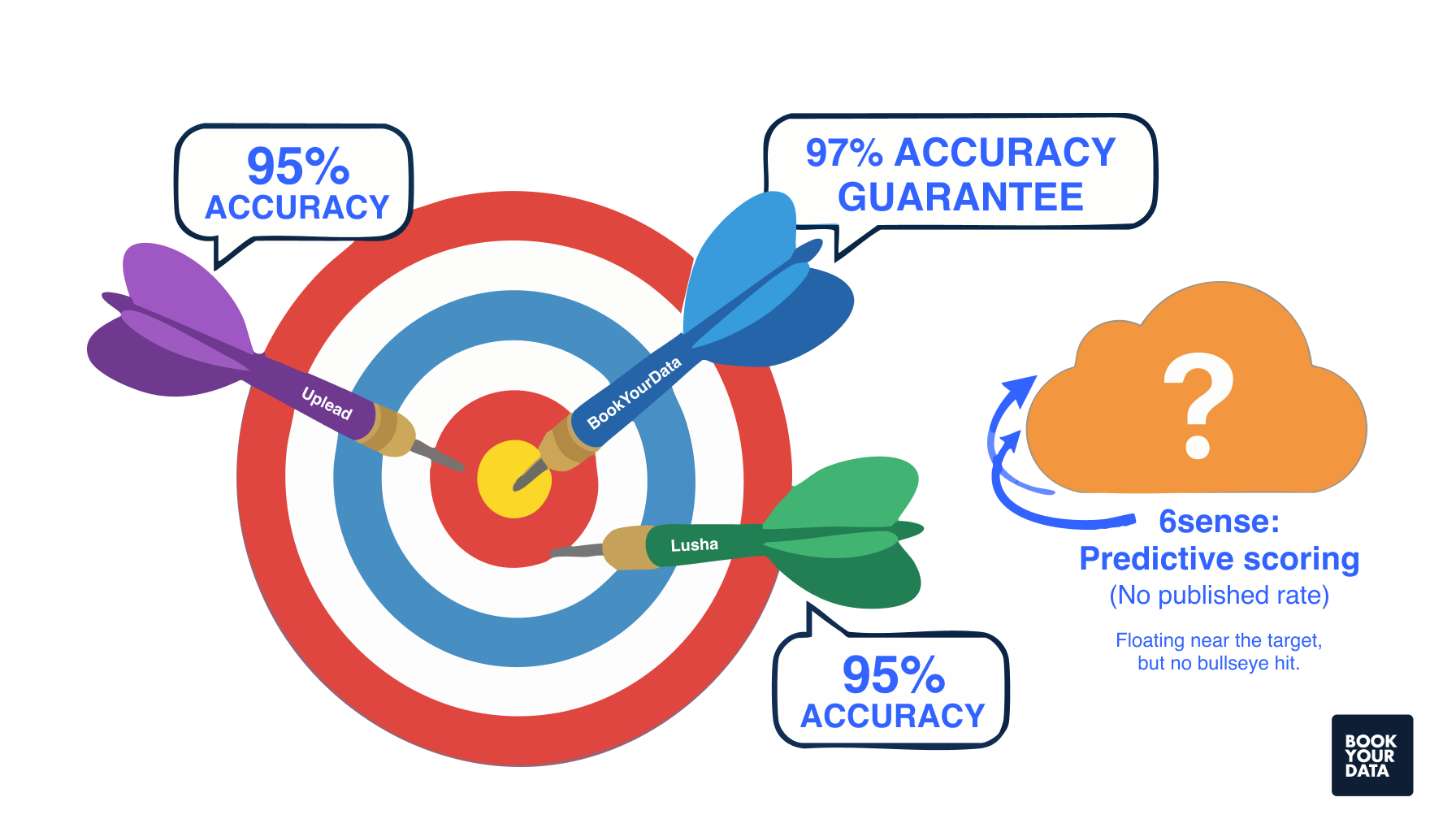
To choose the best 6sense competitor for your business, consider data accuracy, integration with your tech stack, scalability, pricing transparency, ROI, and intent and predictive analytics capability.
Choose competitors that offer real‑time intent data because stale intent signals misguide outreach. High data quality makes sure your business targets accounts that are actually in-market.
Make sure 6sense’s competitor tool integrates smoothly with your existing CRM, like Salesforce and HubSpot, and marketing automation systems. API access and native integrations are important to maintain data flow.
Select a competitor that scales as your business grows, both in terms of data volume and team size. Flexible pricing, like BookYourData’s pay-as-you-go or credit-based, makes sure your expenses stay manageable as your usage and team grow.
Assess the pricing model carefully before choosing the 6sense competitor to confirm there are no hidden fees for add-ons, integrations, or extra features.
Check how strong the competitor’s ability is to surface in-market accounts using predictive or AI‑driven intent scoring. Evaluate how the tool uses machine learning or predictive models to improve lead prioritization.
What makes BookYourData a good alternative to 6Sense for lead generation?
BookYourData is a good alternative to 6sense for lead generation, as it provides a large, accurate B2B contact database with over 250 million contacts and 30 million companies globally. It offers B2B contact lists, real-time email verification to confirm high deliverability, and advanced filtering options for precise targeting by industry, job title, company size, location, and technology use.
Is BookYourData better than ZoomInfo when competing with 6Sense?
Yes, BookYourData is better than ZoomInfo when competing with 6sense because it offers a pay‑as‑you‑go model, so users do not need to sign a costly subscription, and they only pay for the verified contacts they actually download.
What features should companies look for when choosing B2B sales intelligence tools?
The features companies should look for when choosing B2B sales intelligence tools include data accuracy, real‑time intent signals, and deep integration with CRM or marketing tools. Companies should also look for AI‑driven lead scoring or predictive analytics, compliance and privacy support, and usability and automation to scale outreach effectively.
Are there any free competitors to 6Sense for B2B lead generation?
Yes, there are free competitors to 6sense for B2B lead generation. Apollo.io offers a free tier that includes access to its B2B contact database, outreach sequences, and CRM integration. BookYourData gives 10 free credits to test data quality. Lusha also has a free tier, which offers fast and accurate contact data focused on emails and phone numbers.
Is 6Sense an AI sales tool?
Yes, 6sense is an AI sales tool as it uses machine learning and predictive modeling to analyze intent data, score accounts, and identify in‑market buyers.
Is Apollo.io better than 6Sense for sales leads?
Yes, Apollo.io is better than 6sense for sales leads as it provides more accessible pricing and direct contact data compared to 6sense. Apollo.io offers a free tier with unlimited email credits and paid plans starting at $49 per month. 6sense requires an annual investment with complex implementation.
Is BookYourData a good tool for B2B marketing as compared to 6sense?
Yes, BookYourData is a good tool for B2B marketing as compared to 6sense. BookYourData offers over 250M verified contacts with 97% email accuracy. Marketing teams build targeted lists using more than 100 filters without subscription commitments. 6sense excels at account-based marketing with intent signals, but costs more than BookYourData.
Why do marketers prefer BookYourData over Apollo.io?
Marketers prefer BookYourData over Apollo.io because it offers a pay-as-you-go model (no subscription), 97% data accuracy with instant credit refunds, more flexible filtering, and a simple, easy-to-use interface.
What are the top Apollo.io competitors other than 6Sense?
The top Apollo.io competitors other than 6sense are Cognism, ZoomInfo, Seamless.AI, Lusha, Clearbit, and RocketReach.
[CTA1]